You are leaving girlscouts.org for a website opened by an external party. You will be subjected to the privacy and security policies of the website
Above and Beyond: Juliette Gordon Low’s Aviation Adventures and Her Vision for Girls
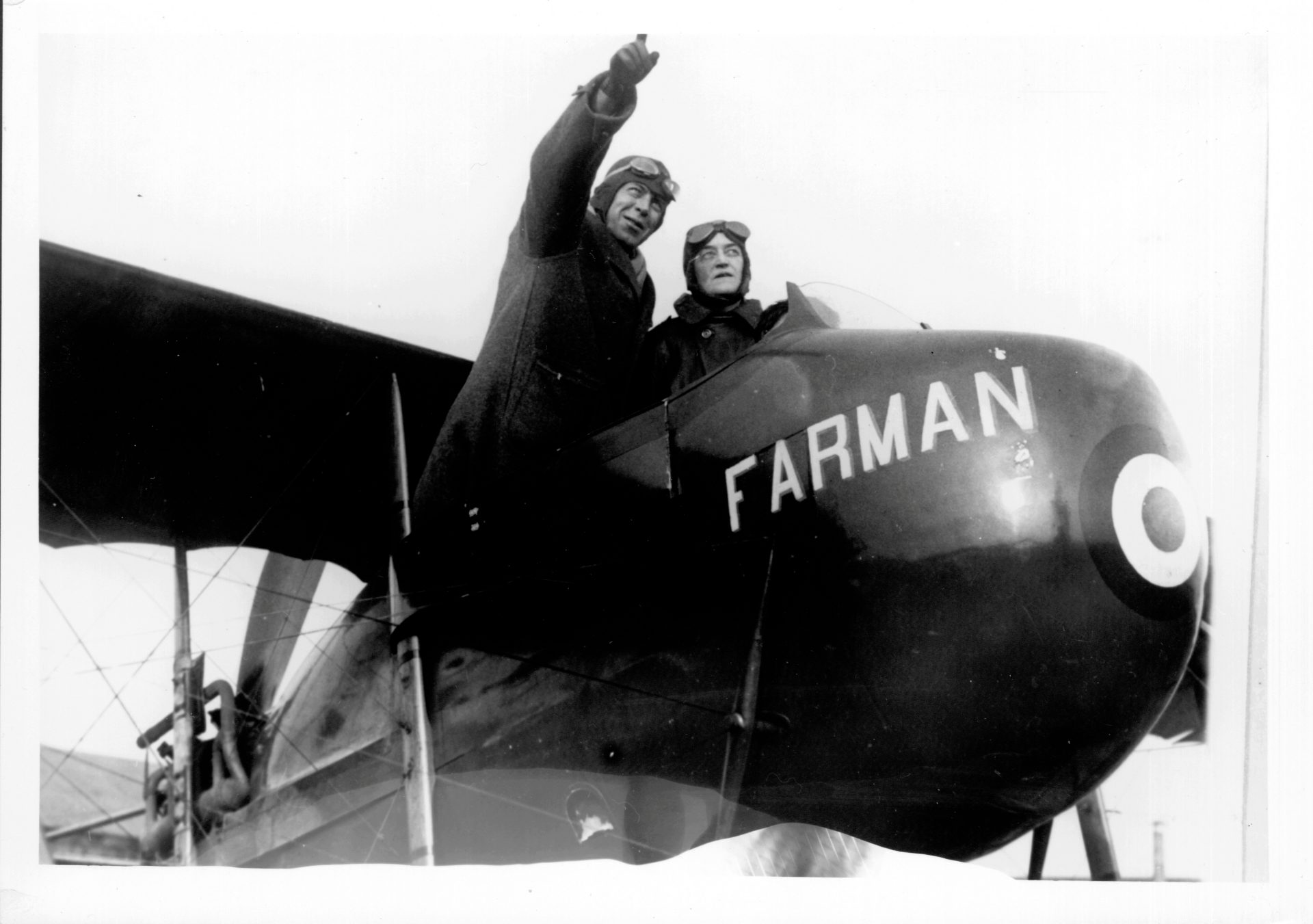
Juliette Gordon Low and pilot Laurence Driggs Aboard a Farman Airplane, 1920s.
Written by Elizabeth Srsic
August 18, 2025
SAVANNAH, GA - In 1913, a mere five years after the Wright Brothers took their first passenger into the air, Juliette Gordon Low enlisted the help of Norman Spratt, daredevil test pilot, to make her dreams of flight come true. Norman Spratt was born in South Africa and served in the Royal Air Force. Prior to World War One, he was a test pilot who set records for speed and altitude. The first ever dogfight, an aerial battle between two aircrafts, was believed to have been between a German two-seater and Spratt in an unarmed biplane – and Spratt won!
When Juliette told her friends she was interested in attempting this new and dangerous sport, they specifically requested that she fly with anyone other than Norman Spratt. Advice she ignored. According to The Remarkable Founder of the Girl Scouts: Juliette Gordon Low by Stacy Cordery, Julitte described this flight as “[…] a delicious experience,’ she exulted - unladylike, exhilarating, and so audacious she meant to keep it a secret [...]” from her family, who would undoubtedly worry. Flying exhibitions and races were popular events for the whole family, but not without their dangers. In the first years of flight, death and tragedy were a common occurrence. Given the dangers, it’s not surprising that Juliette kept her joyrides a secret from her family.
The same year Juliette boarded her first flight, the first Girl Scout handbook, How Girls Can Help Their Country, was published. Juliette was always an advocate for her Girl Scouts to have the same opportunities as Boy Scouts. If Boy Scouts had a badge about aviation, so would Girl Scouts. In 1913, to earn your Flyer badge a Girl Scout must: “Pass tests in knowledge of air currents, weather lore. Must have made an aeroplane fly 25 yards (or have a certificate for driving an aeroplane), and some knowledge of engines.” Many flight schools refused to teach women, so Juliette relied on her vast personal connections and network to ensure that her Girl Scouts had every opportunity to learn the sport.
Although Girl Scouts were given these opportunities, until the 1970s, women aviators’ career prospects were limited. Women who earned their pilots' licenses were only allowed to fly in private planes or do volunteer and support work. A growing number of women—including Girl Scouts— began to challenge the norms despite the limitations placed on female aviators, setting the stage for influential encounters that would further elevate their role in the skies. In June 1920, when business called Juliette to Chicago, she was eager to learn more about the local council’s plan to teach older girls about aviation. Later that year, stuntwoman, aviatrix, and Girl Scout captain Laura Bromwell began lessons for Chicago Girl Scouts. In an interview from 1921, Bromwell spoke candidly about gender and flight:
"I want to be noticed not for what I wear but for what I do. Dangerous? Sure. But if it wasn’t dangerous everybody would be doing it. I wish more women would take to flying. There’s nothing like the fresh air for one’s brains. Then we could have women’s contests. And have all the men look up to us. "
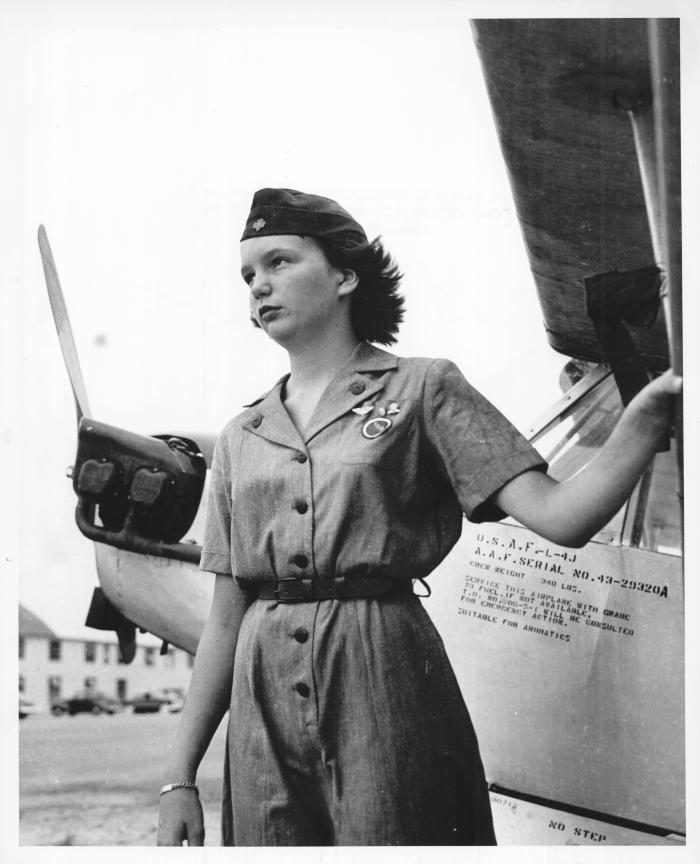
Close-up of a Girl Scout Wing Scout in front of a single-engine Piper Cub airplane parked in a field, circa 1940s.
Laura Bromwell got her start as a thrill-seeker when she jumped off the Roebling Suspension Bridge in her hometown of Cincinnati - a 110-foot drop! A crowd gathered to watch as she jumped, somersaulted in midair, and survived the plunge. Two years later, Bromwell was selling war bonds in Virginia and won a ride on an airplane. Shortly thereafter, she earned her pilot's license and enrolled in the New York City Police Aviation Service, eventually earning the rank of captain. The position was unpaid and volunteer, so Bromwell continued to participate in record-setting exhibitions.
On November 18th, 1920, Juliette planned a thrilling exhibition of her own. To kick-off Girl Scout week, Juliette and famous pilot and novelist, Laurence Driggs, took to the skies above New York City. Leaning out from the aircraft, the sixty-year-old Juliette dropped Girl Scout pamphlets over Central Park, 5th Avenue, and passed by Headquarters on 39th Street. The secret was out, confirming Juliette’s fearless spirit from 3,000-thousand feet in the air!
Juliette Gordon Low’s passion for aviation was more than a personal thrill—it was a bold declaration that girls and women belonged in the skies just as much as their male counterparts. From her daring flight with Norman Spratt to her aerial pamphlet drop over New York City, Juliette embodied the same adventurous spirit she worked tirelessly to instill in her Girl Scouts. At a time when women were often told to stay grounded, she helped them imagine flight—not just as a dream, but as a real and attainable goal. Her legacy lives on in the countless Girl Scouts who dared to explore new frontiers, fueled by the belief that courage, curiosity, and conviction could lift them higher than society ever expected.
Research Sources
Cordery, Stacy A. Juliette Gordon Low: The Remarkable Founder of the Girl Scouts. Viking Penguin, 2012.
Hand, Greg. “Cincinnati’s First (and Fastest) Aviatrix.” Cincinnati Magazine, December 15, 2020. https://www.cincinnatimagazine.com/article/cincinnatis-first-and-fastest-aviatrix/.
Juliette Low takes airplane ride—outtakes. (Fox News Story 5123.) Fox Movietone News Collection. Moving Image Research Collections. University of South Carolina. https://digital.tcl.sc.edu/digital/collection/MVTN/id/170
“Learning from Women in Aviation (U.S. National Park Service).” National Parks Service. Accessed June 29, 2025. https://www.nps.gov/articles/000/learning-from-women-in-aviation.htm.
“License, Aviator Pilot, Civilian, Laura Bromwell.” Smithsonian Learning Lab. Accessed November 19, 2024. https://learninglab.si.edu/resources/view/146439#more-info.
“Original Photograph Aviator Norman Channing Spratt the First Top Gun.” Dear Old Blighty. Accessed November 19, 2024. https://www.dearoldblighty.com/en-GB/all-items/original-photograph-aviator-norman-channing-spratt-the-first-top-gun/prod_18780.
“The Roar of the Crowd.” National Air and Space Museum, September 9, 2022. https://airandspace.si.edu/stories/editorial/roar-crowd.
Silbernagel, Bob. “Driggs: Man behind the Mansion Was Prone to Flights of Imagination.” The Grand Junction Daily Sentinel, September 28, 2017. https://www.gjsentinel.com/lifestyle/columns/driggs-man-behind-the-mansion-was-prone-to-flights-of-imagination/article_444ef0f5-2d05-5732-aa58-421b894c81eb.html.
Simkin, John. “Dogfights.” Spartacus Educational, January 2020. https://spartacus-educational.com/FWWdogfights.htm.
Trapp, Caroline E. “Laura Bromwell and the Legacy of Aerial Policewomen.” National Air and Space Museum, March 12, 2025. https://airandspace.si.edu/stories/editorial/laura-bromwell-legacy-aerial-policewomen.
“Women in Aviation and Space History.” National Air and Space Museum, November 3, 2021. https://airandspace.si.edu/whats-on/exhibitions/women-aviation-and-space-history.
“World War I Photographs Collection Driggs.” National Air and Space Museum. Accessed November 19, 2024. https://airandspace.si.edu/collection-archive/world-war-i-photographs-collection-driggs/sova-nasm-1993-0040.
