You are leaving girlscouts.org for a website opened by an external party. You will be subjected to the privacy and security policies of the website
School Bells and Society Balls: Juliette Gordon Low’s Gilded Age Education
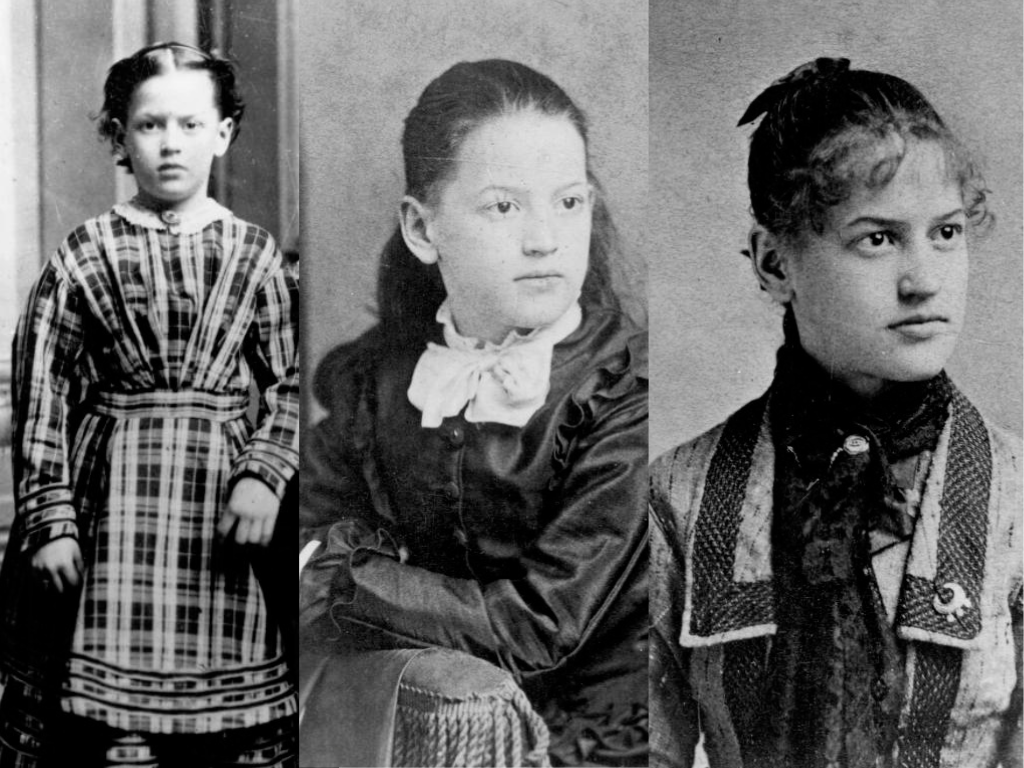
Juliette Gordon Low ages 9, 11, and 18, (left to right).
Written by Elizabeth Srsic | September 26, 2025
SAVANNAH, GA - In 1876, as a yellow fever epidemic raged in Savannah and across the southern United States, fifteen-year-old Juliette Gordon was tucked safely away at Etowah Cliffs in Northern Georgia. Until the epidemic was under control, Juliette’s summer vacation, time spent with her cousins, playing games, performing plays, and publishing a newspaper, was extended into the fall. The opening quote is from a letter Juliette wrote to her mother during that extended holiday, begging to be allowed to quit school. This request was denied, and eventually Juliette returned to Edgehill School in Albemarle County, Virginia.
Juliette came from a long line of educated women, who also believed in supporting causes to further women’s education. In the Gilded Age, during Juliette’s school-age years, she was expected to learn all the proper and necessary skills to become a wife and mother. However, “[e]ducation in the Upper South was more than simply preparation for courtship and marriage; it prepared young women for socially acceptable roles as adults… these women were ‘agents of cultural diffusion.’” Education was a means of distinguishing the social classes and preserving gender roles. For a woman of Juliette’s elite social standing, attending secondary school or even college to pursue a profession was out of the question.
The first twelve years of Juliette’s education took place at home, or in the home of another wealthy, well-educated woman. According to biographer Stacy Cordery, Lucille Blois, a local high school teacher who taught out of her home, likely came to the Gordon household to give instruction to Juliette and her siblings. When she was twelve, Juliette joined her older sister, Eleanor, at a school run by two sisters, the Misses Emmells, in Morristown, New Jersey. According to an advertisement for the school from 1872, the ten boarding students were educated in the “various English branches, in the Ancient and Modern Languages, as well as in music, Drawing and Painting.”
After only one year at Misses Emmells’, Juliette and her sister transferred to the Virginia Female Institute (VFI) in Staunton, Virginia – the same school Robert E. Lee’s daughters attended. The curriculum at VFI focused on traditional subjects like mathematics, history, natural sciences, French, English grammar, spelling, religion, piano, drawing, and elocution. Juliette excelled in her drawing classes but often struggled with spelling. Her letters home often included postscripts, like “please excuse the spelling” probably anticipating correction in her mother’s response. VFI was an Episcopal school, and moral philosophy and religious education was a part of every course of study to prepare the young ladies to take their roles in society.
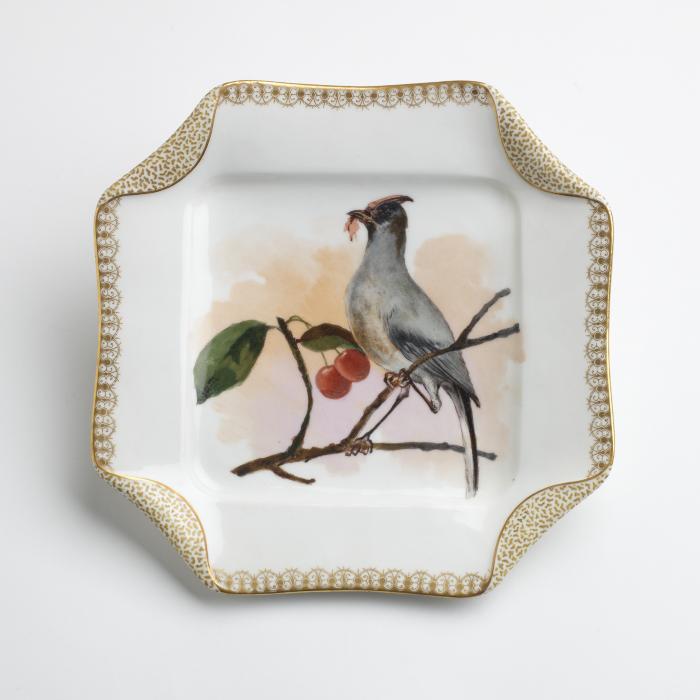
A game plate hand-decorated by Juliette Gordon Low, circa 1880s.
There were no formal curriculum standards at this time. Public education was a fledging endeavor in the Southern United States, which was hindered by geography and post-Civil War realities. The subjects and quality of the education was determined by the education of the educators. The Edgehill School for Young Ladies, which Juliette attended from 1876-1878, was founded and operated by Thomas Jefferson’s daughter and granddaughters in 1829. Jefferson’s wife, daughter, and granddaughters were all highly educated women who studied at the best schools in America and abroad. During Juliette’s time at Edgehill, she added German and geography to her course of study and earned high marks in several of her classes “including piano, speech, drawing, and French… she proudly wore her medal on a gold necklace chain.” As her French improved, so too did her spelling. Only when she was writing in French was her spelling perfect.
Girls attended elite boarding schools like VFI and Edgehill from about age thirteen until seventeen. Then elite upper-class girls enroll in finishing schools. With lessons in elocution, dancing, and etiquette, finishing schools put the “finishing touches” on a young ladies’ preparation for wifehood and their place in society. Their students continued to practice their French and grammar, but their classes were more focused on how to behave and interact with others in the world. During her time at Edgehill, Juliette wrote to her mother:
"I can’t be good in this old school… I don’t do all my duty, and when I say my prayers at night, I’m so, so tired, and sleepy, that I can’t pray for all I want, and in the morning I don’t have time, and I fly into passions, and do bad things… Mama, I can’t keep all the rules, I’m too much like you.”
Juliette’s primary complaints in letters home stemmed from the scrutiny and strict expectations she experienced while at school. This constant surveillance was a part of life for women in society. Every look, appearance, and movement was measured and evaluated by others.
At Juliette’s finishing school run by two French sisters named Charbonnier, in fashionable and thriving New York City, Juliette dressed in a French-style school uniform to study all that was required to become a “suitable partner.” She attended “the Chars” from age seventeen until her official society debut the summer after she turned eighteen. This brief time at the Chars was monumental. Juliette met friends she would hold dear for the rest of her life, Abby Lippitt and Mary Carter, and excelled in her studies, winning awards for French history, literature, and composition. In a letter from 1879, Juliette bragged, “Snub me no more, my precious mother, about my spelling for my French dictee. I came out first!”
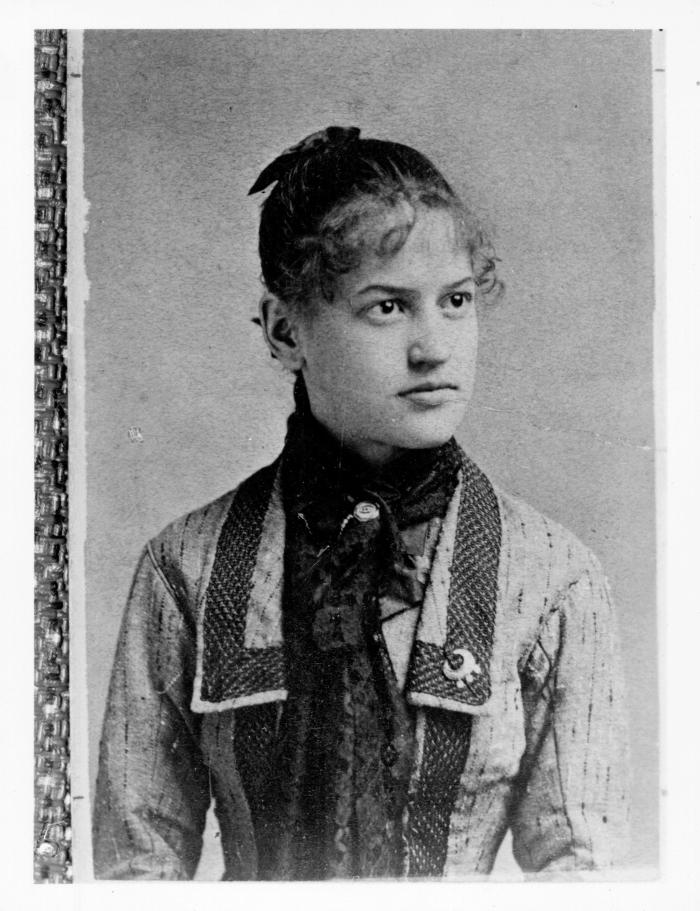
Portrait of Juliette Gordon Low in a gray jacket with a black lace scarf around her neck at approximately 18 years old.
Everything about Juliette’s education was designed to support her role as an upper-class woman who would marry, raise children, maintain a household, and live up to the moral expectations of society. “During the nineteenth century, school officials defined the purpose of schooling as intellectual and moral development of the individual. At the onset of the twentieth century, thirty-forty years after Juliette was in school, preparation for work and citizenship training took command as the fundamental rational for schooling.” Childhood and adolescence same under academic scrutiny for the first time, and new theories surrounding childhood development began to take shape, changing how we understood education forever.
The reform movements that ushered in an era of social change included youth-focused organizations like Girl Scouts. Juliette Gordon Low, who was educated to be a traditional debutante, believed in Progressive Era educational ideals like learning through play and nature studies, and provided girls with the opportunity to experience new and challenging things like basketball and aviation. For a little girl who begged to be allowed to quit school, Juliette was a lifetime learner and, alongside many other likeminded women, developed a new way for girls to expand their horizons beyond the classroom.
Research Sources
- Carnes, Mark C. “DEWEY’S ‘NEW EDUCATION’ AND AN ALTERNATIVE: REACTING TO THE PAST.” The Journal of the Gilded Age and Progressive Era 14, no. 4 (2015): 583–88. http://www.jstor.org/stable/43903539.
Chaddock, Katherine Reynolds, and Susan L. Schramm. A Separate Sisterhood: Women Who Shaped Southern Education in the Progressive Era. New York: Peter Lang, 2002.
Cordery, Stacy A. Juliette Gordon Low: The Remarkable Founder of the Girl Scouts. New York, New York: Penguin Books, 2012.
“Early Girl Scouting.” Georgia Historical Society, November 8, 2023. https://www.georgiahistory.com/resource/juliette-gordon-low/early-girl-scouting/
Graves, Karen. Girls’ schooling during the Progressive Era: From female scholar to domesticated citizen. New York, NY: Routledge, 2016.
Hale, Aaron. “The Long Struggle to Allow Women into UGA.” UGA Today, March 1, 2022. https://news.uga.edu/opening-a-door-100-years-of-women-at-uga/
Harrison, Jennifer, "Nineteenth-century Virginia female institutes, 1850-1890: an analysis of the effect of education on social life" (2000). Master's Theses. Paper 631. https://scholarship.richmond.edu/cgi/viewcontent.cgi?article=1638&context=masters-theses
Kaplan, Andy. “Reconstructing Progressive Education.” Schools: Studies in Education 10, no. 1 (2013): 122–31. https://doi.org/10.1086/670004.
Kiernan, Alison. “The Edgehill School for Young Ladies.” Audio blog. Monticello (blog). The Monticello Foundation. Accessed August 18, 2025. https://www.monticello.org/exhibits-events/livestreams-videos-and-podcasts/edgehill-school-mhpod/
Low, Juliette Gordon, 1860-1927. "Juliette Gordon Low, Personal Correspondence, 1874-1877." 1874/1877. August 13, 2025. https://dlg.galileo.usg.edu/juliettegordonlow/do:318-14-141
Low, Juliette Gordon, 1860-1927. "Juliette Gordon Low, Person Correspondence, 1878." 1878. August 13, 2025. https://dlg.galileo.usg.edu/juliettegordonlow/do:318-14-142
Marten, James, ed. Children and Youth During the Gilded Age and Progressive Era. NYU Press, 2014. http://www.jstor.org/stable/j.ctt9qg20p.
“The Dangerous Experiment.” National Women’s History Museum, August 9, 2018. https://www.womenshistory.org/articles/dangerous-experiment.
