You are leaving girlscouts.org for a website opened by an external party. You will be subjected to the privacy and security policies of the website
A Passport, a Purpose, and a Worldwide Sisterhood: Juliette Gordon Low as a Global Citizen
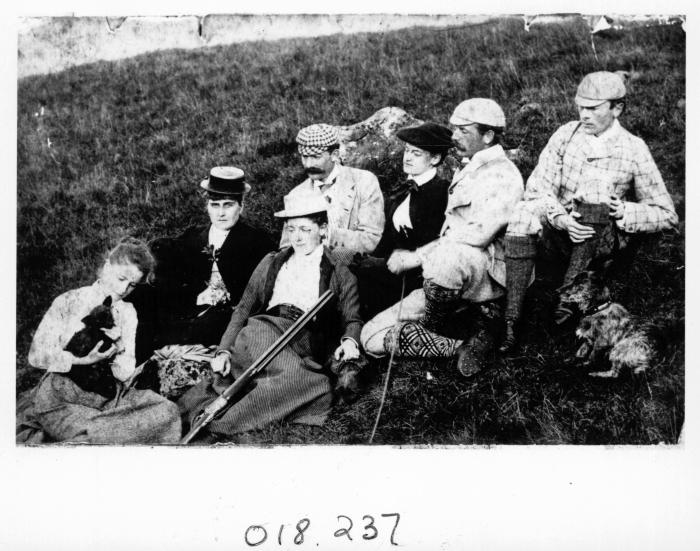
Portrait of Juliette Gordon Low Sitting in Grass with Group of Friends, (1880s).
Written by Elizabeth Srsic | May 19, 2026
SAVANNAH, GA - Juliette Gordon Low is most often remembered as the founder of Girl Scouts of the USA, a role that firmly situates her within national history. Yet restricting her legacy to an American Movement obscures a vital truth: Juliette Gordon Low was, in life and in outlook, a global citizen. Long before she imagined a scouting movement for American girls, Juliette cultivated a worldview shaped by constant travel, sustained international relationships, and engagement with cultures beyond the United States. Her life unfolded across continents, and the values she ultimately embedded in Girl Scouting such as service, adaptability, curiosity, and international sisterhood, were forged through decades of global mobility. To understand Juliette Gordon Low fully, we must first understand her as a world traveler.
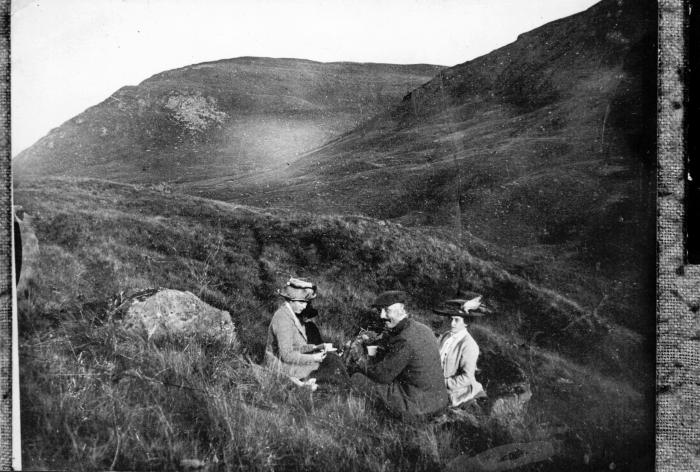
Portrait of Juliette Gordon Low Enjoying Scottish Countryside with Friends, (1880s).
Juliette’s international life began in 1882, when at the age of twenty-one she undertook her first journey abroad. Like many women of her class, she traveled within socially acceptable frameworks: chaperoned tours, cultural study, and artistic refinement. Yet this conventional entry into international travel marked a significant expansion of her horizons. She moved through England, France, Germany, and Switzerland, encountering European art, history, and landscapes firsthand. Although her motivations were deeply personal, entwined with her ill-fated romance with her future husband William Mackay Low, the experience awakened a lifelong appetite for movement and exploration. Travel quickly became not merely an interlude, but a defining condition of her adult life.
Juliette’s marriage to William Low in 1886 placed her squarely within British society and permanently oriented her life across the Atlantic. Despite promises to settle part-time in Savannah, the Lows spent most of their married years in the United Kingdom, and Juliette crossed the ocean repeatedly for the rest of her life. These transatlantic passages created a rhythm of existence that pushed beyond national boundaries. Juliette belonged equally to British and American social worlds, and later, to an expanding international network of Girl Guides and Girl Scouts.
Juliette’s travels expanded beyond Europe into the far reaches of the British Colonial Empire. In 1891, she and Willy were invited by the commander in chief of the Anglo-Egyptian army and his wife to visit them in Egypt. Juliette and Willy made the journey together, traversing landscapes shaped by empire, archaeology, and colonial power. There, she rode camels and donkeys to desert ruins, explored tombs and monuments, and climbed a pyramid (a popular activity for travelers). Her subsequent return to Egypt in 1894 was facilitated by further British military connections. Through friendships with officers stationed across imperial outposts, Juliette gained access to experiences, correspondence, and movements that proved useful as her marriage declined.
Juliette’s travels to India in 1905 and again in 1907 marked a further expansion of her global consciousness. Moving across the subcontinent, she observed religious rituals, festivals, architecture, nature, and daily life firsthand. Her experiences ranged dramatically, from aristocratic hospitality, such as extended stays with the Maharajah of Kolhapur and breakfasts with Princess Bamba Singh, to physically demanding journeys through ruins and rural landscapes. India confronted Juliette with the contradictions of empire, privilege, and cultural difference. While her perspective remained shaped by her privileged social position, these journeys confirmed her belief that meaningful knowledge came only through encounters and experiences.
In 1905, widowhood further shaped Juliette’s mobility. No longer constrained by marital expectation, she traveled widely and often in the company of young women she chaperoned. She believed deeply in the educational power of travel for girls. International exposure cultivated resilience, empathy, and confidence; qualities she would later embed centrally in Girl Scouting. Her mentorship of girls abroad in some ways functioned as an early, informal experiment in global youth development.
Juliette’s transformation from world traveler to global organizer occurred after an encounter with Sir Robert Baden-Powell and learning of the emerging scouting movement. By the time she met him, Boy Scouting had already become an international phenomenon, spanning multiple countries and cultures. Juliette immediately recognized in scouting a structure capable of harnessing her lifelong commitments: outdoor education, service, community, and self-reliance. Her prior travels had taught her that shared experience could bridge differences, and scouting offered a practical mechanism to institutionalize that belief.
After founding Girl Scouts in 1912, Juliette insisted on thinking internationally. She moved between London, Savannah, New York, and Washington, while maintaining close involvement with Girl Guides in the United Kingdom and beyond. World War I intensified her global orientation. With personal ties across Europe and deep emotional investment in the conflict’s outcome, Juliette treated international service not as abstraction but as urgent necessity. Her war work, like housing refugees, demonstrated a commitment to international friendship and responsibility.
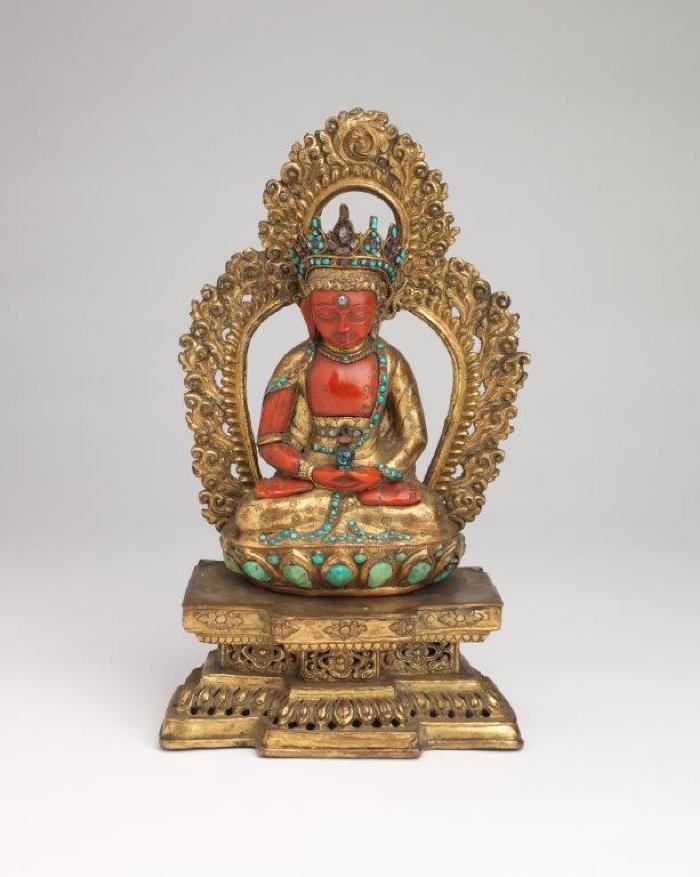
Buddha Figurine, (n.d.).
After the war, Juliette was a forceful advocate for international Girl Guiding and Girl Scouting. Juliette stepped down as president of Girl Scouts of the USA in 1920 in order to dedicate her time to this mission. She supported the creation of the International Council, attended conferences across the Atlantic, housed and funded foreign delegates, and pressed American Girl Scouts to resist isolationist tendencies. At a time when the United States increasingly turned inward, Juliette insisted that Girl Scouts must learn to think beyond national borders. She believed that sustained relationships among young people, cultivated through shared programs and mutual understanding, offered one of the most promising paths toward lasting peace.
Juliette’s final years were characterized by urgency and vision. Despite declining health, she worked relentlessly to secure the Fourth World Camp to be held stateside at Camp Edith Macy in 1926; it was the first international gathering held outside the United Kingdom. This gathering brought together representatives from twenty-nine countries, embodying her belief that global cooperation was not only possible but necessary. The establishment of World Thinking Day further symbolized her conviction that international awareness should be a permanent, recurring practice in the lives of Girl Scouts.
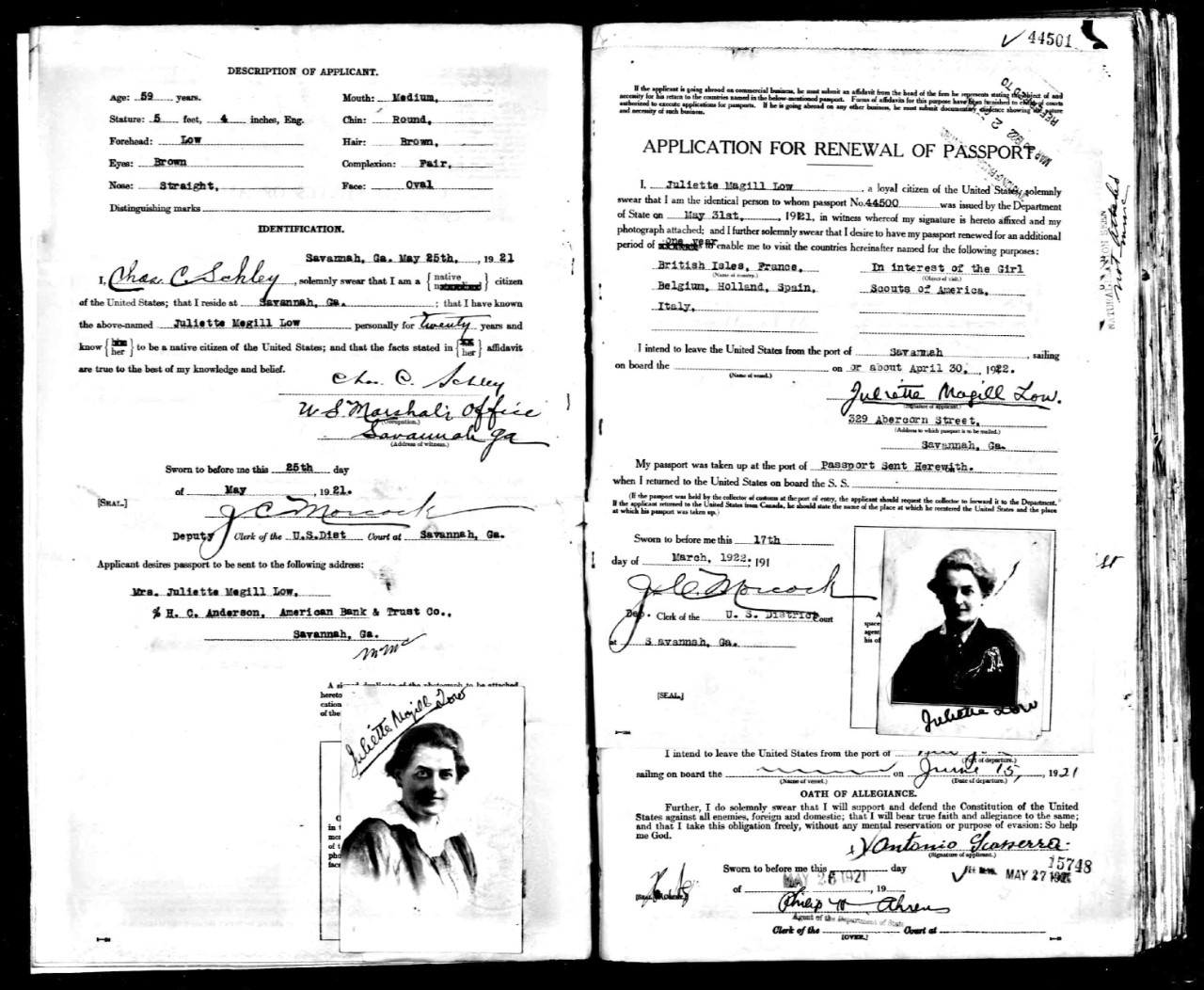
Juliette Gordon Low's Passport Application, (1921).
Juliette Gordon Low died in 1927, having witnessed the realization of her most ambitious dream: a truly global sisterhood of Girl Guides and Girl Scouts. Juliette’s worldview was shaped by relentless travel, cross-cultural friendships, and firsthand engagement with the wider world, which made her uniquely suited to imagine a movement that transcended borders. Remembering her as a global citizen is not an abstraction but a faithful reflection of how she lived. Long before “global citizenship” became a common phrase, Juliette Gordon Low practiced it daily, one journey at a time.
This post was adapted from a series of talks given by Shannon Browning-Mullis, Executive Director of the Juliette Gordon Low Birthplace and VP of Cultural Assets, GSUSA.
