You are leaving girlscouts.org for a website opened by an external party. You will be subjected to the privacy and security policies of the website
A Special Friend to the Girl Scouts: Walter J. Hoxie and the Power of Nature-Based Learning
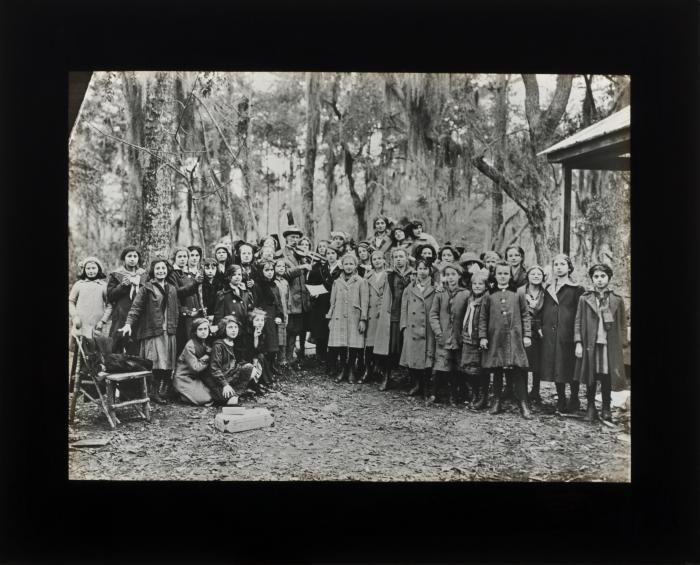
Walter Hoxie Plays Violin Among Girl Scouts, (1912).
Written by Elizabeth Srsic | April 24, 2026
“We live our lives in this world of nature, through its storm and shine, amid its silent, eternal forces; and upon it our spiritual as well as out physical heath depends.”
– The Way of Understanding, Sarah Louise Arnold, 1934.
SAVANNAH, GA - Underneath the thick clouds of smog and soot of the Industrial Revolution, the Progressive Era movements of nature preservation, conservation, and education began. It was a common belief that spending time in nature protected the spiritual and physical welfare of city-dwelling children. In 1877, Reverend Willard Parsons began the wildly successful Fresh Air Fund, which still raises money to sponsor week-long trips to the countryside for urban children. At its inception, the organization raised money from middle- and upper-class families, as well as the ultra-wealthy like Cornelius Vanderbilt, Whitelaw Reid, and William E. Dodge, to fund nature experiences for tenement children. Rev. Parson’s relatively simple idea became an ideal quintessential to public education and youth organizations during the turn-of-the-century, including Girl Scouts of the USA.
In 1912, the newly formed American Girl Guides, soon after named Girl Scouts, called upon the semi-retired teacher and naturalist, Walter J. Hoxie to lead nature excursions near his home and property in Bona Bella, Savannah. Jane Judge, journalist and Girl Scout board member, wrote in a 1913 article for Savannah Morning News:
“The Girl Scouts have no better friend in Savannah than Mr. Hoxie. From the very beginning he has interested himself in their affairs and has become a specially valuable companion on their country walks and camping parties. Through Mr. Hoxie they have learned much about the Nature World...”
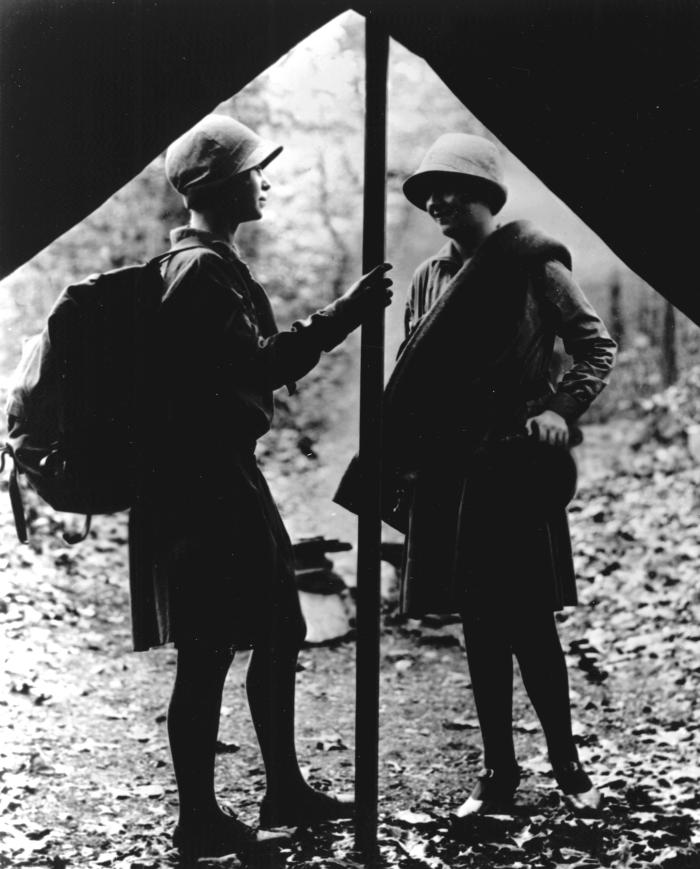
Posing with Gear at the Entrance to a Tent, (1928).
Hoxie also contributed to the first Girl Scout handbook published in 1913, How Girls Can Help Their Country, and wrote the entirety of “Part II: Camping,” which included information about plants, animals, and astronomy specific to North America.
Hoxie’s education began at home with his mother, Elizabeth, who “raised [him] on Nuttall’s Ornithology” and “a botany called The Plants of Boston.” In 1865 he graduated from Putnam Free School in Newburyport, Massachusetts and enrolled in a special course in physics and mathematics. That same year, at the age of seventeen, he went to work for the astronomical division of the U.S. Coast Survey before beginning his career as a schoolteacher a year later.
As a schoolteacher, Hoxie held positions throughout Massachusetts and South Carolina, including the first school for the formerly enslaved and the first teacher’s college for Black Americans on St. Helena Island, South Carolina, which were created as part of the Port Royal Experiment. At each of his posts, Hoxie emphasized the importance of nature education and learning by observing one’s surroundings.
During his teaching career, he published numerous articles in academic journals for teachers on science and mathematics, as well as advice on behavior and charming recollections of outings and field trips with students. In an 1877 article in the National Journal of Education entitled “School-Gardening,” Hoxie reminds his fellow teachers that nature education isn’t merely for the student’s benefit.
“Teachers undertaking a school-garden need not be afraid that it will give them extra work. It merely slips little scraps of vacation into every day, and aids nearly every lesson. It is, of course, a help to discipline, for so is every loop-hole through which the teacher gets a glimpse of the inner-self of his pupils, which, through mistaken notions of dignity and useless formalities, is too often totally hidden from him.”
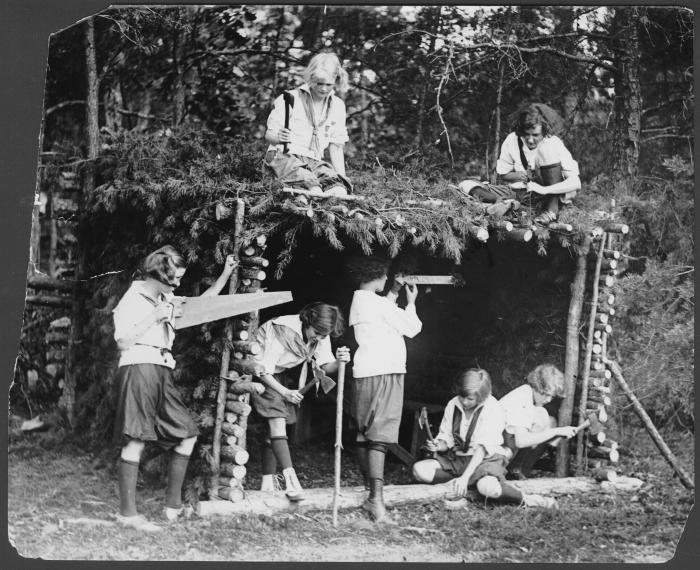
Girl Scout Intermediates Work on the "Hoover Hut" at Camp Juliette Low, Georgia, (1920s).
To Hoxie and to other progressive educators, learning by doing and through play was more valuable than rote memorization, which had been the norm for generations. As Elizabeth B. Peabody, who founded the first English-language American Kindergarten, explained in the 1883 edition of The Kindergarten Messenger:
“The object of the Kindergarten is to form and open the mind of childhood, rather than to fill it. It is called kindergarten by Froebel, for a somewhat whimsical but perfectly just reason, that it treats the little child as the wise gardener treats the plant…”
Hoxie also used the New York Times to demonstrate the historical roots of current international and domestic conflicts and how stock market reports related to goods production in the South. After observing drawn-upon and annotated maps of Turkey during the Russo-Turkish War, a school committee member curled “the lip of scorn” and said, “That’s not geography; its newspaper.” Hoxie replied, “What’s newspaper but geography and history?” Today, anyone who’s been in the classroom might remember a section of the day’s lesson dedicated to current events and not think it a radical idea, but at this time, recess and playgrounds were radical ideas.
In Savannah, another subscriber to progressive educational methods and cousin of Juliette Gordon Low, Nina Anderson Pape, began her teaching career in 1895 at Massie School. In her first year, she founded the Fresh Air Home on Tybee Island, in the style of Rev. Parsons, and enrolled in correspondence courses in experimental education. By 1900, Nina and a colleague resigned to start a new school, which unfortunately struggled due to creative differences. After falling out with her teaching partner, Nina spent some time in Europe with her cousin Juliette before returning to Savannah to open the Pape School in 1908. Within that eight-year time frame, several key events took place that would intertwine the lives of Hoxie with the founding members of the Girl Scouts.
In 1901, Hoxie moved to Savannah and served as the superintendent of the Bethesda Home for Boys, then later worked as a taxidermist, commercial photographer, surveyor and inspector for the railroad (nature impact studies for new construction), and a writer for the Savannah Morning News. Shortly after Hoxie began working for the newspaper, future Girl Scout board member, Jane Judge, resigned from teaching to accept a journalist position at the same paper. Then in 1907, while Nina Pape was reforming her school program, the Baldwin Kindergarten Association and Savannah Kindergarten Club found new leadership in the “strongly progressive thinker,” Hortense Orcutt.
Two years after the Pape School was founded in 1910, Nina Pape added a Kindergarten program, and the school building became the official meeting place for the Savannah Kindergarten Club, of which Jane Judge was also a member. That same year, Nina Pape recruited Hoxie, perhaps through their mutual connection, Jane Judge, to lead nature walks with her students. They formed a special nature study club under Hoxie’s direction. So, when Nina Pape’s cousin called her in 1912 with “something for all the girls of Savannah” and wanted a core component of this idea to be camping and nature, Nina Pape knew exactly who to rely on.
During Hoxie’s time in Savannah, he routinely hosted Girl Scouts for nature walks, pond-dipping, and camping excursions while still finding time to write over 500 articles for newspapers and journals. His persistent message across all his writings is one of love and appreciation for nature and a need to foster the spirit of exploration and conservation in youth.
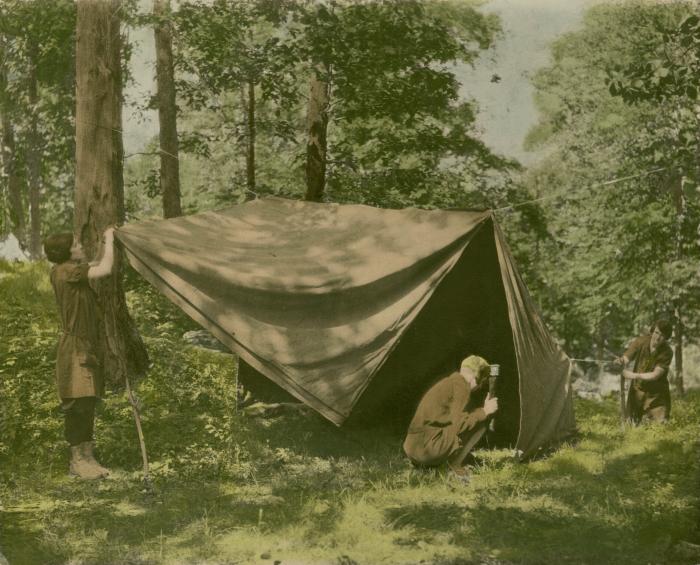
Three Girl Scouts Pitch a Wall Tent in the Woods, (1920s).
In 1920, his youngest daughter, Mary Russell Day, briefly moved into Hoxie’s home in Savannah with her husband and son, and by 1923, the entire household moved to St. Petersburg, Florida. Mary Russell was also a schoolteacher and taught nature studies through hands-on learning. In 1924, Mary Russell founded Pinellas County’s first Girl Scout troop and remained active in the organization until her death in 1964. The final ten years of Hoxie’s life are not as deeply chronicled as his professional life, but it is not a stretch to imagine that he continued to work with his daughter’s students and Girl Scouts.
Taken together, the life and work of Walter J. Hoxie illustrate how Progressive Era ideals of nature education, experiential learning, and conservation became embedded in youth organizations through lived practice rather than abstract theory. Hoxie’s contributions to the first Girl Scout handbook and his hands-on guidance of early troops ensured that nature study was not merely recreational but foundational to character-building and citizenship. His legacy in the Girl Scout Movement can be seen in the lives of early Girl Scouts who were able to experience nature firsthand, some for the first time, a quiet but enduring testament to the power of progressive teaching grounded in nature, curiosity, and community.
Research Sources
- Arnold, Sarah Louise. The Way of Understanding. New York: Girl Scouts of the U.S.A, 1934.
Carmichael, Jason T., J. Craig Jenkins, and Robert J. Brulle. “BUILDING ENVIRONMENTALISM: The Founding of Environmental Movement Organizations in the United States, 1900-2000.” The Sociological Quarterly 53, no. 3 (2012): 422–53. http://www.jstor.org/stable/41679727.
Fargo, William G. (1934) "Walter John Hoxie," Wilson Bulletin: Vol. 46 : Iss. 3 , Article 6. Available at: https://digitalcommons.usf.edu/wilson_bulletin/vol46/iss3/6 .
“From Savannah to St. Petersburg: The Start of Girl Scouting in Pinellas County.” St. Petersburg Museum of History | St. Petersburg, Florida, March 11, 2026. https://spmoh.com/pinellas-girl-scouts/.
Guarneri, Julia. “Changing Strategies for Child Welfare, Enduring Beliefs about Childhood: The Fresh Air Fund, 1877—1926.” The Journal of the Gilded Age and Progressive Era 11, no. 1 (2012): 27–70. http://www.jstor.org/stable/23249057.
How Girls Can Help Their Country, 1913.
Hoxie, Walter. “School-Gardening.” New England Journal of Education 6, no. 7 (1877): 73–74. http://www.jstor.org/stable/44744777.
“‘THE NEWS.’” New England Journal of Education 6, no. 5 (1877): 53–53. http://www.jstor.org/stable/44769925.
Hoxie, Walter. “A Dip in the Pond.” New England Journal of Education 2, no. 1 (1875): 5–5. http://www.jstor.org/stable/44766167.
Hoxie, Walter. “EVERY SATURDAY. BOBBY AND I.” National Journal of Education 10, no. 21 (1879): 339–339. http://www.jstor.org/stable/44959811.
Jordan, Ben. “‘Conservation of Boyhood’: Boy Scouting’s Modest Manliness and Natural Resource Conservation, 1910–1930.” Environmental History 15, no. 4 (2010): 612–42. http://www.jstor.org/stable/25764486.
Marten, James, and Paula S. Fass. Children and Youth During the Gilded Age and Progressive Era. S.l.: NYU Press, 2023.
Miller, Susan A. Growing Girls: The Natural Origins of Girls’ Organizations in America. New Brunswick, N.J: Rutgers University Press, 2007.
Merchant, Carolyn. “Women of the Progressive Conservation Movement: 1900-1916.” Environmental Review: ER 8, no. 1 (1984): 57–85. https://doi.org/10.2307/3984521.
Moore, Waveney Ann. “Girl Scout Works to Honor Pioneers.” Tampa Bay Times, December 23, 2019. https://www.tampabay.com/archive/1999/06/16/girl-scout-works-to-honor-pioneers/.
Pressly, Paul. “Educating the Daughters of Savannah’s elite: The Pape School, the Girl Scouts, and the Progressive Movement.” The Georgia Historical Quarterly, SUMMER 1996, Vol. 80, No. 2 (SUMMER, 1996), pp. 246-275.
Riley, Glenda. “Victorian Ladies Outdoors: Women in the Early Western Conservation Movement, 1870-1920.” Southern California Quarterly 83, no. 1 (2001): 59–80. https://doi.org/10.2307/41172052.
Rome, Adam. “Nature Wars, Culture Wars: Immigration and Environmental Reform in the Progressive Era.” Environmental History 13, no. 3 (2008): 432–53. http://www.jstor.org/stable/25473262.
“‘Political Hermaphrodites’: Gender and Environmental Reform in Progressive America.” Environmental History 11, no. 3 (2006): 440–63. http://www.jstor.org/stable/3986027.
Whitham, Hilary. “Some Thoughts on the Early History of Kindergarten - Tenement Museum.” Edited by Jamie Salen. Tenement Museum, April 24, 2020. https://www.tenement.org/blog/some-thoughts-on-the-early-history-of-kindergarten/.
