You are leaving girlscouts.org for a website opened by an external party. You will be subjected to the privacy and security policies of the website
"Hidden Heroines" Series: Caroline Woodbridge
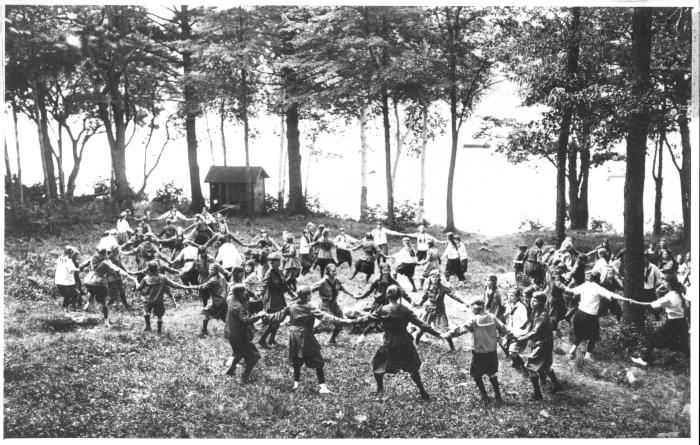
Girl Scouts join in a circle dance, c. 1919.
Written by Elizabeth Srsic | November 20, 2026
SAVANNAH, GA - Fifty years ago in 1976, we celebrated the American Bicentennial. As a part of the festivities, Girl Scouts of the USA created a nation-wide program that highlighted the work and accomplishments of women across the country. Each council presented their "Hidden Heroines" through a series of local and national events and a bound publication which was gifted to Girl Guide alum, Queen Elizabeth II.
In honor of the sesquicentennial, we are sharing the stories of other founding members of the Girl Scout organization, our own "Hidden Heroines." This month, we're sharing the story of Caroline Woodbridge, a Savannah socialite, Progressive reformer, and the first Girl Scout treasurer.
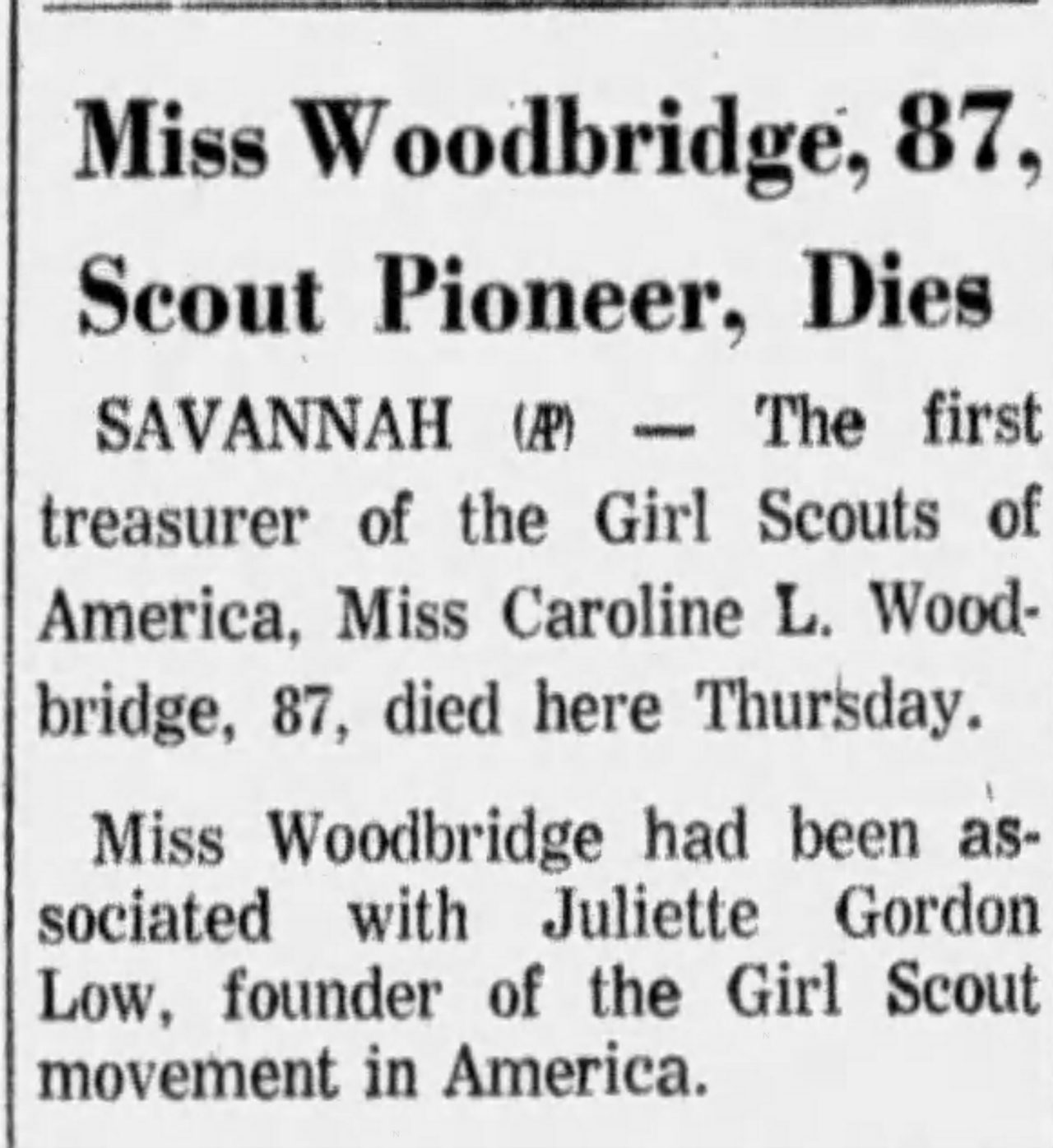
Caroline Woodbridge Obituary, Atlanta Constitution, c. 1960.
Caroline Woodbridge
The life of Caroline "Lina" Woodbridge (1874-1960) illustrates the important role that elite women's civic networks played in shaping Savannah's charitable, educational, and youth organizations during the late nineteenth and early twentieth centuries. Although remembered today primarily as an early Girl Scout leader and the first treasurer of the Girl Scouts organization, Caroline's contributions extended well beyond Girl Scouting, including a broader reform movement that sought to improve educational opportunities, public health, and recreational experiences for children in Savannah.
Caroline Woodbridge was born into a prominent Savannah family. Through her mother, Eliza Woodbridge Cunningham, she was the granddaughter of Colonel Charles Augustus Lafayette Lamar, a notable and controversial figure remembered as the last recorded Confederate casualty of the American Civil War. The Woodbridge and Cunningham families occupied a respected position within Savannah society and maintained substantial influence through business, civic, and charitable activities.
Newspaper accounts from the 1890s and early twentieth century place Caroline firmly within Savannah's social elite. Society columns regularly reported her participation in teas, receptions, weddings, holiday celebrations, card parties, and luncheons. She served as maid of honor at her sister Lilla Woodbridge's wedding in 1893, participated in numerous charitable entertainments, and frequently hosted gatherings at the Cunningham residence on Oglethorpe Avenue, just down the street from the Juliette Gordon Low Birthplace.ts.
While such activities reflected the expectations placed upon upper-class women of the period, they also provided the social infrastructure through which many civic initiatives operated. Historians have noted that women's social networks frequently served as foundations for reform organizations, charitable associations, and community improvement projects. Caroline's later work in philanthropy emerged directly from these networks of friendship, kinship, and civic responsibility.
Among Woodbridge's most significant affiliations was the Froebel Circle, a local chapter of the International Order of the King's Daughters and Sons. Founded in Savannah on May 27, 1897, at the home of educator Nina Pape, the organization represented an important expression of Progressive Era philanthropy. As a branch of the King's Daughters, an international Christian service organization founded in 1886, the Circle emphasized practical charitable work rooted in religious principles and focused particularly on the welfare of children.
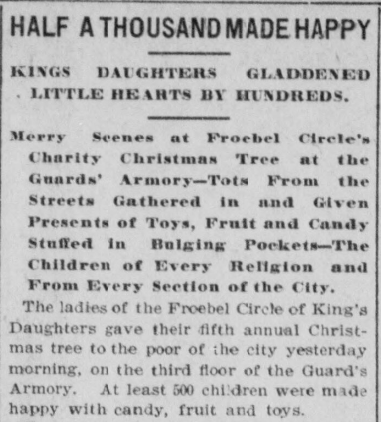
Article about the Frobel Circle's Christmas charity activities, Savannah Morning News, c.1899
Named after the German educator Friedrich Froebel, founder of the kindergarten movement, the Circle reflected contemporary interest in child development, education, and social reform. Its motto, drawn from Matthew 25:40, emphasized service to society's most vulnerable members: "Inasmuch as ye have done it unto one of the least of these my brethren, ye have done it unto me." The organization's chosen scripture, Isaiah 11:6, "A little child shall lead them," further underscored its child-centered mission.
Caroline became an active member of the Froebel Circle by at least 1899. Contemporary newspaper accounts identify her alongside Nina Pape and Sallie McAlpin, who would later become founding members of the Savannah Girl Scouts, as participants in the organization's major charitable initiatives. These included annual Christmas celebrations for disadvantaged children and support for the Fresh Air Home at Tybee Island, one of Savannah's most significant welfare projects of the era.
The Fresh Air Home sought to improve the health of underprivileged children by providing access to fresh air, recreation, and temporary respite from the crowded urban environment. Such institutions reflected a widespread belief among Progressive Era reformers that exposure to nature and recreation could improve children's physical and moral well-being. Caroline assumed substantial responsibilities and served as treasurer of the Fresh Air Home project, a role important enough that another woman was appointed to manage her duties during an extended absence in Canada in 1900.
In January 1904, she was elected treasurer of the Froebel Circle. In that capacity, she helped oversee the financial administration of one of Savannah's most active charitable organizations during a critical period of growth. Caroline's work through the Froebel Circle and related civic organizations intersected naturally with the development of the Girl Scout Movement in Savannah. The same network of educated, community-minded women who supported educational reform, public welfare, and wartime volunteerism also helped establish and sustain early Girl Scouting. Soon after the founding on March 12, 1912, Caroline became the first Girl Scout treasurer.
This connection was strengthened through her family relationship with Mildred Cunningham, her stepsister and a prominent early Girl Scout leader. Census records demonstrate the close relationship between the two women, who shared a household for decades. Both participated in the circle of Savannah women who devoted themselves to community service, youth development, and public engagement, including a training in 1916 for national preparedness and wartime service efforts.
Caroline's civic influence extended well into the twentieth century. In 1936, she was recognized by the Savannah Women's Club as one of the founders of the city's Community Christmas Tree Project, an initiative that became a longstanding holiday tradition. Alongside leaders such as Nina Pape and Caroline Meldrim, she helped create a program that embodied the values central to her life's work: community responsibility, child welfare, and public service.
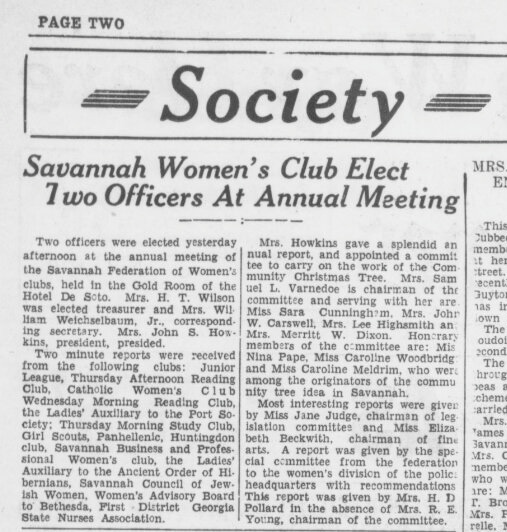
Article about Caroline Woodbridge serving on a committee about a community Christmas tree, Savannah Daily Times, c. 1936.
Caroline Woodbridge's life reflects the broader history of women's civic leadership in Savannah during the Progressive Era and beyond. Through her work with the Froebel Circle of the King's Daughters, her support of child welfare initiatives, and her contributions to the early Girl Scout Movement, she exemplified a generation of women whose influence was exercised through voluntary associations and community service. Her repeated involvement in projects focused on children is particularly notable. Whether through holiday celebrations, the Fresh Air Home, educational efforts inspired by Froebel's philosophy, or the emerging Girl Scout Movement, Caroline consistently directed her energies toward improving opportunities for young people. Though she never held public office, her efforts helped establish institutions and traditions that shaped Savannah's civic culture for decades.
Caroline's contributions were sufficiently important that her obituary, published following her death in 1960, identified her as a Girl Scout pioneer, acknowledging how her administrative and financial expertise, developed through years of charitable work, played a significant role during the formative years of Girl Scouting. Caroline died at St. Joseph's Hospital in Savannah on March 23, 1960, and was buried in Bonaventure Cemetery. Her legacy endures not only through her association with Girl Scouts, but also through her lifelong commitment to philanthropy, education, and the welfare of Savannah's children. As both a civic reformer and community builder, Caroline Woodbridge occupies an important place within the history of Savannah's charitable and educational movements.
Research Sources
Caroline Woodbridge Biography File, Juliette Gordon Low Birthplace Museum, compiled 2026.
