You are leaving girlscouts.org for a website opened by an external party. You will be subjected to the privacy and security policies of the website
"Hidden Heroines" Series: Edith Johnston
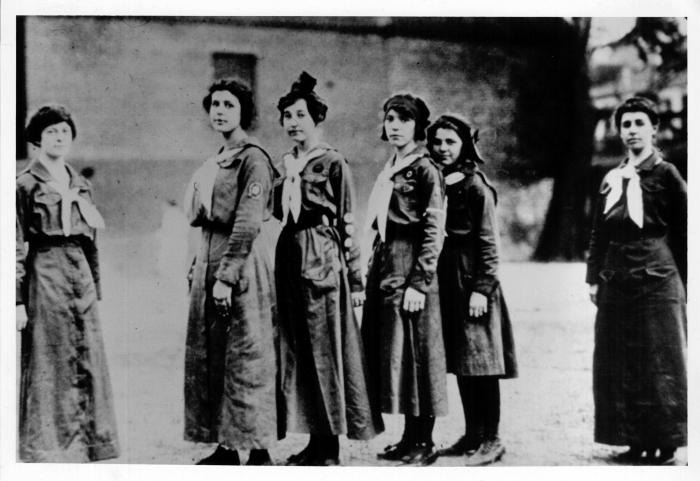
Four Girl Scouts pose in a line with two Adult Leaders on each side. Edith Johnston is on the far right, 1914.
Written by Elizabeth Srsic | August 24, 2026
SAVANNAH, GA - In 1976, fifty years ago, we celebrated the American Bicentennial. As a part of the festivities, Girl Scouts of the USA created a nation-wide program that highlighted the work and accomplishments of women across the country. Each council presented their "Hidden Heroines" through a series of local and national events and a bound publication which was gifted to Girl Guide alum, Queen Elizabeth II.
In honor of the sesquicentennial, we are sharing the stories of other founding members of the Girl Scout organization, our own "Hidden Heroines."
Edith Johnston
Savannah socialite, talented organizer, and historian, Edith Duncan Johnston was the secretary of the Savannah Girl Scouts in 1912-1913 and the first National Secretary.
Edith was born in September 1878 to a merchant family led by James Houstoun Johnston, a descendant of Founding Father William Houstoun. As a teenager, Edith made repeated appearances in the society pages of Savannah Morning News for hosting parties and gatherings. When she was eighteen, she graduated from the Bryn Mawr School in Baltimore, Maryland. At the time, Bryn Mawr was one of the most holistic and rigorous educational opportunities available to women.
Not long after graduation, Edith returned to Savannah and began working as an assistant at the Morton's School for Boys. The Morton School for Boys was the "only private school in this city whose certificate boys enter the State University without an entrance examination.” Over the next few years, Edith worked her way up in the ranks of the school by continuing her education by taking a Chautauqua course.
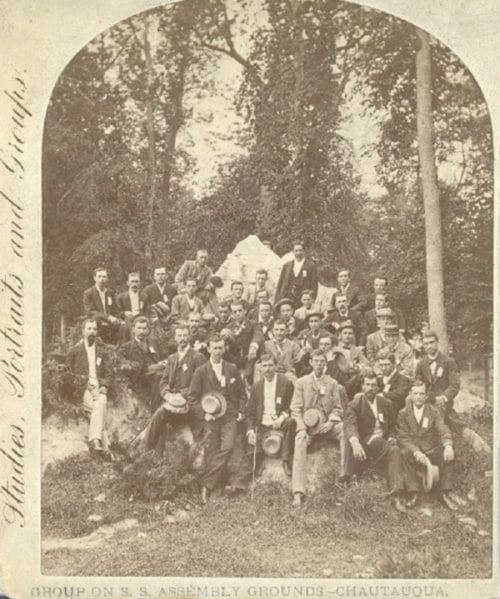
Group from the Chatauqua Institution on the S.S. Assembly Grounds Chautauqua, 1877. Oliver Archive Center.
Chautauqua assemblies were an adult education and social movement that began in the 1870s in Chautauqua, New York as a summer-camp style training school for Sunday School teachers. The format was incredibly flexible and popular and expanded beyond Sunday school topics to include speakers, lecturers, and performers from across multiple disciplines, including notable social reformers like Maud Ballington Booth and Jane Addams. In 1902, Edith Johnston travelled to New York for her course, but by 1904, "Circuit" or "Tent Chautauquas" travelled across the country to provide educational and spiritual opportunities outside traditional classroom settings.
Now in her late twenties, Edith, perhaps inspired by her time in Chautauqua, became more involved with Progressive Era reforms, including the College Aid Association and working as a clerk in a social work office. Social Work evolved from charitable volunteerism to a formalized profession between the end of the Civil War and the early 1900s and was one of the few career opportunities available to women at a time when more middle and upper-class women were entering professional fields.
Edith was detailed, organized, and meticulous. When Juliette Gordon Low approached her to become the National Secretary in 1912, Edith's fastidious nature was often at odds with Juliette's opinionated flightiness. As the National Secretary, Edith kept records of daily activities at the headquarters office and wrote monthly, mid-year, and annual reports of events, curriculum, membership numbers, equipment purchases, and budgets, as well as phone calls and visits to the office. She was also a gifted publicist and began writing advertisements and articles for newspapers promoting Girl Scouts making a difference in their communities, while also having fun.
Perhaps inspired by her time at Bryn Mawr, Edith organized a basketball league for Girl Scouts. They played in an empty lot, which was screened in for modesty, next to the First Headquarters building. When working Girl Scouts could only play after work in the evenings, Edith arranged for the city to install electric lights on the court. Basketball was so popular that Edith had to issue a memo to leaders to remind the girls that Girl Scouting was not only a basketball club.
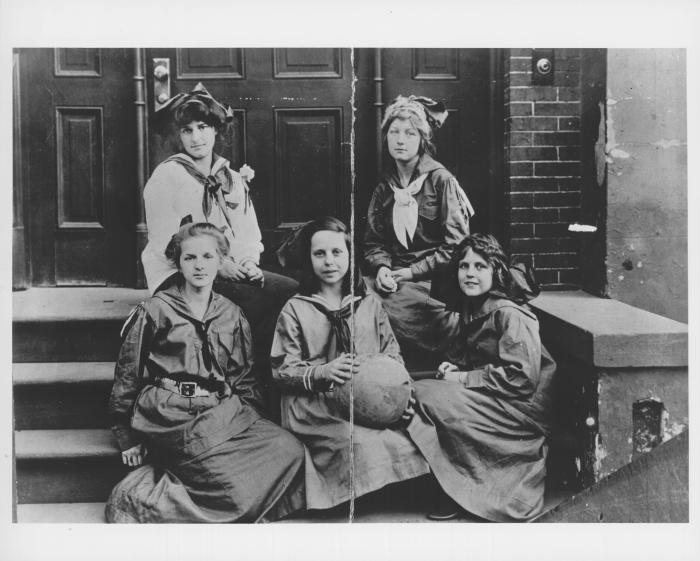
Carnation Girl Scout Troop pose with a basketball, 1913.
When headquarters moved to Washington DC in 1913, Edith stayed on as National Secretary for a year before returning to work as a secretary for the Savannah Girl Scouts. Despite this transition, Edith continued to include notes from the national organization in her reports, while keeping records of Savannah Girl Scouts.
In 1917, Edith left the Girl Scout organization for a new post as publicity director of the Episcopal Diocese of Georgia and represented Christ Church in Savannah. Both the Gordons and Edith's family were members of Christ Church. As the publicity director, Edith organized, advertised, and reported events for the diocese. In 1925, she gave a lecture on church publicity at the 20th Annual Session for the Council of Colored Churchmen, a segregated branch of the Episcopal Diocese of Georgia.
After retiring from the Episcopal Diocese, Edith spent the remainder of her public and professional life on another passion: history. In 1931, Edith was named the chairman of historic activities for the Georgia Society of the Colonial Dames, which was founded by Juliette Gordon Low's mother Eleanor Kinzie Gordon. As chairman, Edith erected a plaque in honor of news titan Julian LaRose Harris, "the earliest and most uncompromising anti-Klan voice in the Georgia press," at the site of the Georgia Gazette.
Edith was also a founding member of the Savannah Historical Research Association. The Savannah Historical Research Association was organized in 1934, "for the purpose of gathering, preserving, and disseminating the history of Savannah, Georgia." The association agreed to supervise the compiling of data documenting the history of Chatham County.
This comprised indexing old Savannah newspapers, The Colonial Records of Georgia, The Revolutionary Records of Georgia, cemetery records, abstracting Chatham County wills, marriage records, etc. These indices were typed and bound and have become invaluable research volumes in many libraries. Members of the association also prepared papers on many phases of Savannah history which were presented at the meetings. (Georgia Historical Society)
Several of Edith's historical papers and articles were published in the Georgia Historical Quarterly, including the Kollock Letters, which provided valuable insights into the social and political life of Savannah from 1799-1850. At age 73, in 1951, Edith’s decades of historical research culminated in an academic monograph, The Houstouns of Georgia, which documents the history of Edith's family from their Scottish roots to settling Georgia to the founding of the United States.
Edith Duncan Johnston's life reflects the many ways women shaped the civic, educational, and cultural life of the early twentieth century. From organizing basketball leagues for Savannah's first Girl Scouts and building the administrative foundations of the Movement to promoting the work of the Episcopal Diocese and preserving Georgia's historical record, Edith brought the same qualities of diligence, intellect, and public service to every endeavor she pursued. Her careful documentation not only helped the Girl Scout Movement grow during its formative years but also ensured that future generations would have a richer understanding of Savannah's past. Through her work as an educator, organizer, publicist, and historian, Edith left a legacy that continues to inform the history of Girl Scouting and the story of Georgia itself.
Stay tuned for future installments in our "Hidden Heroines" series as we uncover more of the women behind the Movement.
Research Sources
- Canning, Charlotte. “University Libraries: The University of Iowa.” Traveling Culture: Circuit Chautauqua in the Twentieth Century. Accessed August 16, 2026. https://www.lib.uiowa.edu/sc/tc/.
Edith Johnston Biography File, Juliette Gordon Low Birthplace Museum, compiled 2026.
“Edith Johnston.” Georgia Press, June 9, 2025. https://www.ugapress.org/author/edith-johnston/.
Episcopal Church - New Georgia Encyclopedia. Accessed August 16, 2026. https://www.georgiaencyclopedia.org/articles/arts-culture/episcopal-church/.
File, 111240, GSUSA Corporate Records, 1948-1963.
GHS 0433 Edith Duncan Johnston papers. Georgia Historical Society, Savannah, Georgia.
GHS 0994 Savannah Historical Research Association records. Georgia Historical Society, Savannah, Georgia.
Kollock letters, 1826-1860, typescript copies. Originals of these letters are at the University of Georgia and the University of North Carolina., Box: 1, Folder: 2. Kollock family papers, Manuscript Collection No. 476. Stuart A. Rose Manuscript, Archives, and Rare Book Library. https://archives.libraries.emory.edu/repositories/7/archival_objects/254541 Accessed August 16, 2026.
Mugleston, William F. “‘Julian Harris, the Georgia Press, and the Ku Klux Klan.’” The Georgia Historical Quarterly 59, no. 3 (1975): 284–95. http://www.jstor.org/stable/40580187.
Ruth, Betty J, and Jamie Wyatt Marshall. “A History of Social Work in Public Health.” American Journal of Public Health, December 2017. https://pmc.ncbi.nlm.nih.gov/articles/PMC5731072/.
Tannenbaum, Nili, and Michael Reisch. “From Charitable Volunteers to Architects of Social Welfare: A Brief History of Social Work | University of Michigan School of Social Work.” University of Michigan School of Social Work, 2001. https://ssw.umich.edu/about/history/brief-history-of-social-work.
