You are leaving girlscouts.org for a website opened by an external party. You will be subjected to the privacy and security policies of the website
"Hidden Heroines" Series: Hortense May Orcutt
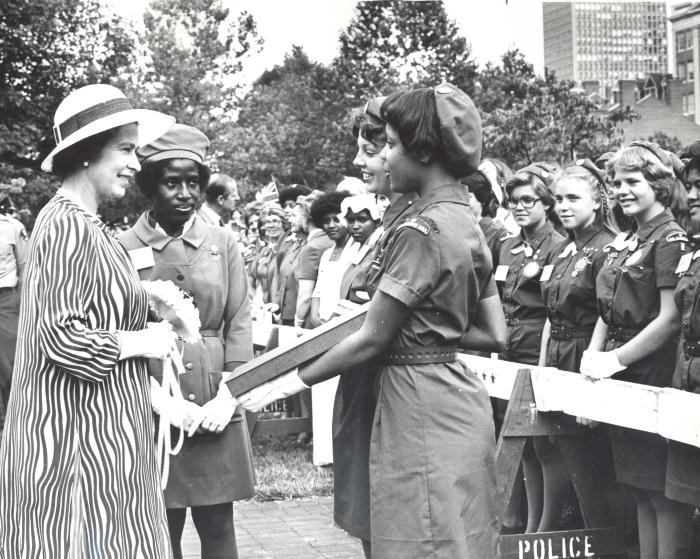
Girl Scouts Present a Gift to Queen Elizabeth II and Dr. Gloria Scott, 1976.
Written by Elizabeth Srsic | July 24, 2026
SAVANNAH, GA - In 1976, fifty years ago, we celebrated the American Bicentennial. As a part of the festivities, Girl Scouts of the USA created a nation-wide program that highlighted the work and accomplishments of women across the country. Each council presented their "Hidden Heroines" through a series of local and national events and a bound publication which was gifted to Girl Guide alum, Queen Elizabeth II.
In honor of the sesquicentennial, we are sharing the stories of other founding members of the Girl Scout organization, our own "Hidden Heroines." Beginning with Girl Scout board member, educator, and suffragist, Hortense Orcutt.
Hortense May Orcutt
Hortense May Orcutt was a lifelong educator and advocate for innovative and progressive education. Hortense was born in Massachusetts on October 2, 1874, and later attended the Ethical Cultural School in New York City. At the Ethical Cultural School, she was trained in the educational philosophy of the kindergarten movement, which believed in learning through play, self-expression, and hands-on activities over traditional methods like rote memorization. While in New York, Hortense taught in the psychology department at the Ethical Cultural School and several other private institutions before moving to Savannah in 1907.
In Savannah, Hortense became the supervisor of the Kate Baldwin Free Kindergartens. The Kate Baldwin Free Kindergartens were founded in 1899 by the children of Kate Baldwin in memory of their mother. The first kindergarten was opened in Yamacraw, and over the next few years four additional kindergartens, both free and tuition-based, opened. When Hortense took over, she "pushed the organization into a more ambitious direction," according to historian and educator Paul M. Pressly. Hortense also
"...sponsored clubs for adolescent boys and girls that offered a mixture of folk dancing, games, story telling, handicrafts, as well as an occasional ice cream party. She pioneered the notion that the clubs, made up of 'deprived' adolescents, should have self-governing constitutions in hopes that their members would learn the rudiments of democracy. Simultaneously, she initiated festivals of various shapes and sizes, bringing young children and adolescents together for a variety of celebrations, all of which enhanced the idea of doing more for all of Savannah's youth." (Pressly, 1996)
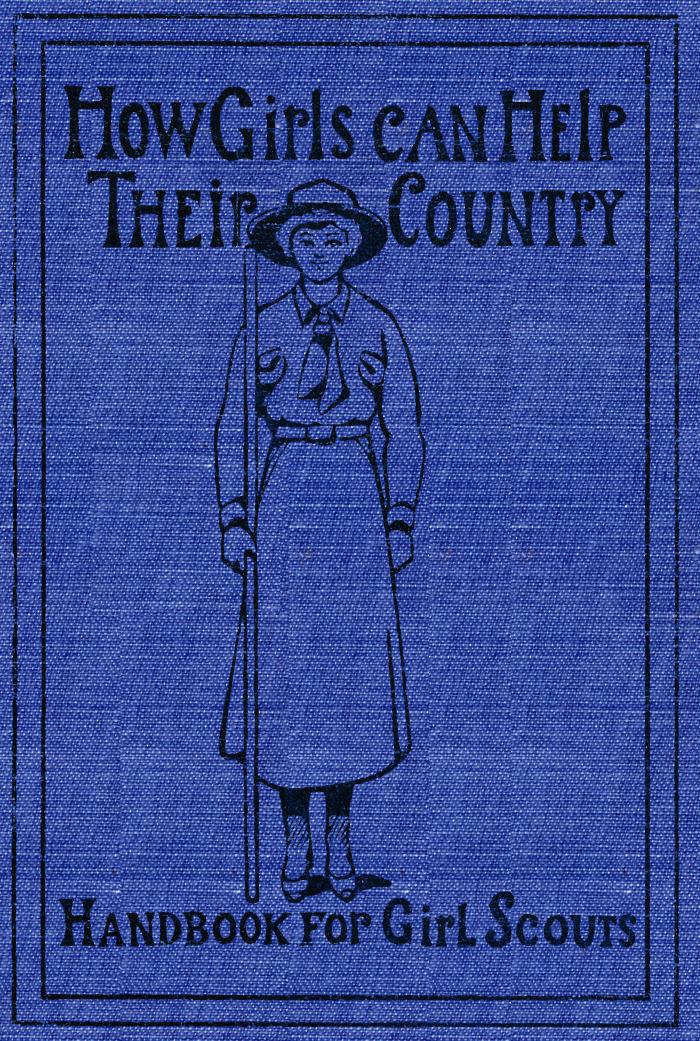
How Girls Can Help Their Country,
Over her years in Savannah, Hortense was also a member of the Savannah Kindergarten Association, vice-president of the International Kindergarten Union, a member of the Savannah chapter of the League of Women Voters, a board member for the public library system, and a founding member of the Savannah Play Festival Association, which advocated for public playgrounds. Other members of these clubs and organizations were other early Girl Scout leaders, board members, and supporters like Carol Oppenheimer, Edith Johnston, Jane Judge, and Nina Pape. When Juliette Gordon Low made her famous, and perhaps folkloric, phone call to her cousin Nina Pape in early 1912, she was tapping into an intricate and established network of Savannah women who were already making strides to improve the lives of children.
Hortense swiftly joined the "Board of Councilors" of the fledgling organization that would become Girl Scouts of the USA. The Board was responsible for setting the curriculum, raising funds, and organizing their newly recruited leaders and volunteers. In 1913, their work included converting the British Girl Guide handbook, How Girls Can Help to Build Up the Empire, into a new handbook. By writing new passages that would be relevant to American girls, their efforts produced the first Girl Scout handbook, How Girls Can Help Their Country.
In the 1920s, Hortense split her time between Savannah and Massachusetts. When she was in Savannah, she lived with teacher, journalist, and early Girl Scout supporter, Jane Judge. During this time, Hortense contributed to publications on the history of the kindergarten movement, maintained her position as supervisor of the free kindergartens, and added the additional role of principal of the teacher training school.
Though often overlooked, Hortense Orcutt played a vital role in building the foundations of Girl Scouting and expanding opportunities for young people in Savannah. Her legacy lives on in the values of leadership, service, and civic participation that remain central to Girl Scouts today. Hortense Orcutt's legacy reminds us that the success of the early Girl Scout Movement was built not only by Juliette Gordon Low's vision, but also by a network of dedicated women who shared a commitment to education, civic engagement, and the well-being of young people.
Stay tuned for future installments in our "Hidden Heroines" series as we uncover more of the women behind the Movement.
Research Sources
1880-1930 United States Federal Census
Annual Message to the City Council of Hon. Wallace J. Pierpont Mayor on the Finances and Improvements of 1917. Savannah, GA, 1917.
GHS 1503 Hortense M. Orcutt papers. Georgia Historical Society, Savannah, Georgia.
Kate Baldwin Free Kindergarten Records, 1899-1938. UNC Chapel Hill Archives. https://finding-aids.lib.unc.edu/catalog/02834
“Miss Hortense M. Orcutt; Savannah Kindergarten Head Had Taught in New York” New York Times, January 22, 1936. https://www.nytimes.com/1936/01/22/archives/miss-hortense-m-orcutt-savannah-kindergarten-head-had-taught-in-new.html
"Obituary for Hortense Orcutt" Newspapers.com. The Atlanta Constitution, January 23, 1936. https://www.newspapers.com/article/the-atlanta-constitution-obituary-for-ho/37203530/.
Orcutt, Hortense. “A Loving Appreciation.” Essay. In Pioneers of the Kindergarten Movement in America, 20–20. New York, New York: The Century Co., 1924.
“Savannah.” Essay. In History of the Kindergarten Movement in the Southeastern United States and Delaware, District of Columbia, New Jersey and Pennsylvania, 20–21. Atlanta, GA, 1939.
Secretary’s monthly and annual reports on the organization, Sarah McAlpin and Edith Johnston, 1912-1914, JGLBM Archives.
