You are leaving girlscouts.org for a website opened by an external party. You will be subjected to the privacy and security policies of the website
Juliette Gordon Low and the Belgian Refugee Crisis
Written by Elizabeth Srsic | November 20, 2025
SAVANNAH, GA - On the eleventh hour of the eleventh day of the eleventh month of the year, at long last, the “war to end all wars” was finally over. Four years, three months, and seven days earlier, on August 4, 1914, Juliette Gordon Low, her mother, and her sister’s children were renting Castle Menzies in Scotland and preparing for the worst. Germany had just invaded Belgium, and England issued an ultimatum requesting Germany withdraw their troops from Belgium with a deadline of 2:00 PM. By the time Juliette was writing a letter to her sister, Mabel, who was living in London, the deadline had lapsed. “8 PM, August 4th, 1914: Dearest Mabel, War seems inevitable.” Three hours later, England declared war.
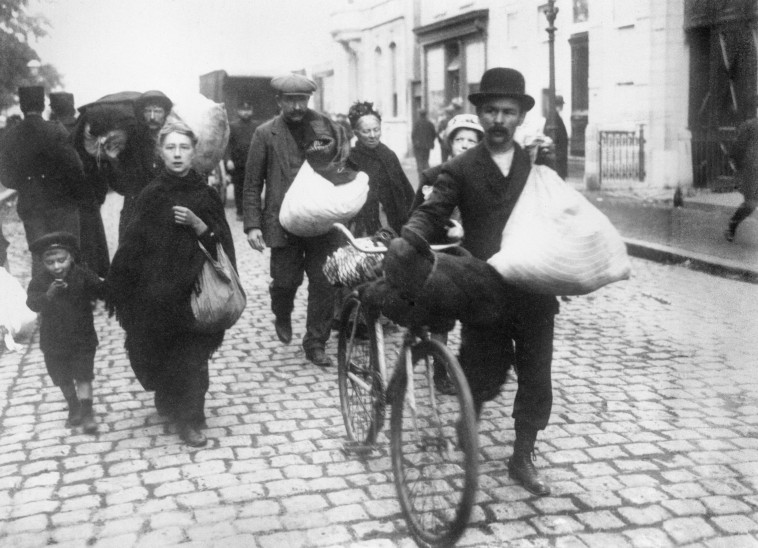
The first few days of the war were frantic. Juliette wrote to her sister nearly every day begging her to join them in Scotland and strategizing how they could get their mother and the children safely home to the US. Meanwhile, Belgian civilians were fleeing the German schrecklicheit. Their villages were shelled or burned, and those who could not escape were executed. Nearly one and a half million Belgians were displaced in the first month of the war. Many fled to France and soon the British government arranged for ships to carry refugees to British soil. Wave upon wave of Belgian refugees landed on the British coast, and organizations like the War Refugees Committee quickly formed to answer the call to action.
Lady Flora Lugard worked as a journalist for the Pall Mall Gazette, the Manchester Guardian, and as the colonial editor of The Times. She was the highest-paid woman journalist in her time. Lady Lugard could see the writing on the wall: war and the inevitable displacement of innocents was not a question of “if” but “when,” and “will we be ready?” England had begun making preparations to address the unrest in Ireland, including a plan for evacuating refugees, but when Germany invaded Belgium, civil war was delayed for another decade. After learning of the atrocities of the initial attack, Lady Lugard telegraphed her connections in the British military asking if the pre-existing models and plans could be reworked to aid in the evacuation of Belgium.
He telegraphed back immediately that everything they had was at my disposal for such a purpose. He sent me all their registration forms – forms which we are to-day using at the War Refugees’ Committee – and put me immediately in touch with people who had the necessary information. In twenty-four hours I had the embryo of an organization in my hands.” — Lady Ludgard, 1915 speech recorded in the Journal of the Royal Society of Arts.
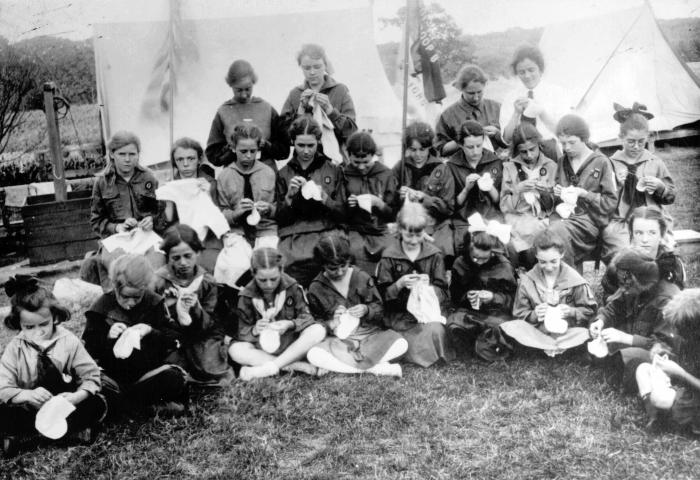
Girl Scouts of of New Bedford Sew for Belgian Children During WWI, 1918.
On Saturday, August 22nd, Lady Lugard received word from the Admiralty that they were embarking on their first voyage to collect refugees. At this stage, there was no committee or infrastructure beyond a handful of people and a stack of forms. By Sunday evening, they found an office space and placed an ad in the Monday morning paper. On Monday, without ink, paper, desks, or chairs, they received the first refugees and over 1,000 letters from English citizens offering aid and assistance. The War Refugees Committee was off and running, as were Juliette and Mabel.
With Nellie and the children safely on their way back to the States, Juliette and Mabel turned their attention to war work. Juliette began supporting the Girl Guides’ efforts and planning for how her U.S. Girl Scouts could contribute to the cause. Mabel, who never did join Juliette in Scotland, joined the Lady Lugard Hospitality Committee’s executive committee, a subset of the War Refugees Committee that provided assistance and accommodation to upper class Belgian refugees. Mabel knew from Juliette’s previous letters that Castle Menzies had ample space and supplies (especially given that Juliette had begun stockpiling fuel and budgeting food in the days leading up to Britian declaring war) and wrote to Juliette about taking in a family. Juliette replied in a letter dated October 30th [1914]:
“Yes I will take any refugees with or without servants. It would be more private for me to have them take dinner and supper at Weem hotel and let me give them breakfast, but I’ll do anything to help as long as it don’t run me deeper into debt. Any way you chose to fix it and I am ready for them.”
Sometime after, a family of Belgian refugees was settled into Castle Menzies, and Juliette took responsibility for their living expenses. There are family stories that have been passed down that imply Juliette Gordon Low was not the best manager of money and financial matters. When her mother Nellie, only recently back in the United States, learned that Juliette was taking on an entire family’s living, she was less than enthusiastic: “As to doing for the Belgians I think your first obligation is to your Scouts over here! If you can’t keep up the salaries of your very important [Girl Scout] heads over here, why “monkey” with the Belgians?” Wartime financial hardship was hardly a unique experience, and when the Menzies family declared bankruptcy, Juliette and the Belgians (once again) found themselves temporarily adrift.
While worrying that some of her furniture and belongings were mixed up with the Menzies’s and repossessed along with everything else in the castle, Juliette arranged an “awfully nice apartment” for the Belgian family in her care. After her affairs were tied up, Juliette embarked on a dangerous journey back to America aboard the Lusitania. It would be the ship’s last voyage before it was torpedoed by an Imperial German Navy U-boat. Back in the United States, Juliette turned her attention to rallying the Girl Scouts to support their Girl Guide sisters in war work. It would still be two more years until the United States officially joined the fight, but, after all, the Girl Scout motto is “Be Prepared.”
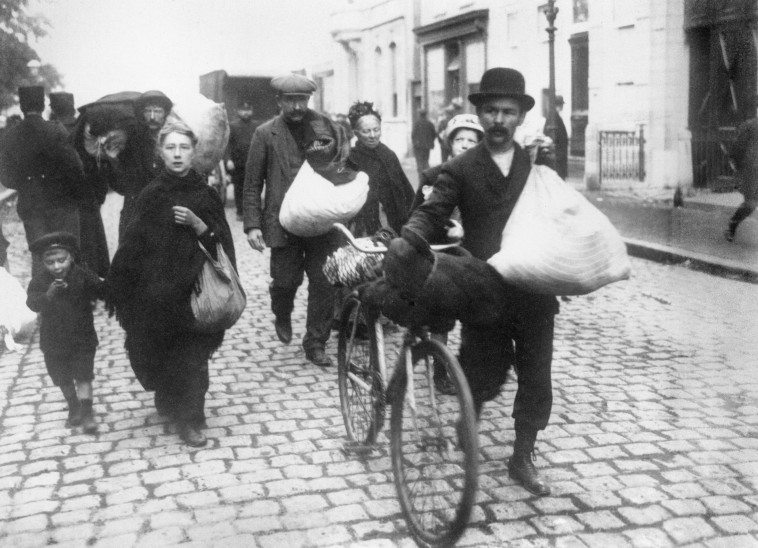
Refugees fleeing Antwerp during WWI, via the Imperial War Museum.
During the war, when she was able to travel back and forth between the United States and England, Juliette visited “her Belgians” and joined Mabel at fundraising events and to take new arrivals shopping for essentials. Beyond these occasional mentions in letters, it is difficult to say exactly how the Belgian families in Juliette and Mabel’s care spent their days until the war’s end or how and when they made their return. Many Belgian refugees filled labor shortages at factories or worked at schools or stores in entirely insular Belgian communities. The general consensus is that Belgian refugees “kept to themselves” and, by 1919, most returned home making the “largest ever single displacement” of refugees to Britain also one of the most forgotten.
If you are interested in reading more about the World War One contributions of Girl Guides in the UK, Voices of War and Peace provides a good overview and this post from the official Girl Guide blog focuses on the work Guides did for MI5. For more information about how Girl Scouts supported their scouting sisters abroad and later their country when the US joined the fight, these posts by Georgia Historical Society and the National Women’s History Museum are a great place to start. If you are going to be in Washington D.C. in July 2026 for the 58th National Convention, visit our exhibition in the Hall of Experiences to learn more about Girl Scouts and our legacy of service.
Research Sources
- Cordery, Stacy A. Juliette Gordon Low: The Remarkable Founder of the Girl Scouts. New York, New York: Penguin Books, 2012.
Declerc, Dr. Christophe. “Belgian Refugees in Britain: A Short Summary.” Royal Tunbridge Wells Belgian Refugees 191419. Accessed October 13, 2025. https://blogs.kent.ac.uk/rtwbelgians/belgian-refugees-in-britain-a-short-summary/.
De Vuyst, Jollen. “Refugee Relief during the First World War.” Voices of War and Peace, 2019. Link.
Flora (née Shaw), Lady Lugard - person - National Portrait Gallery. Accessed October 13, 2025. https://www.npg.org.uk/collections/search/person/mp65594/flora-nee-shaw-lady-lugard.
“How Belgian Refugees Kept the British Army Going during the First World War.” Imperial War Museums. Accessed October 13, 2025. https://www.iwm.org.uk/history/how-belgian-refugees-kept-the-british-army-going-during-the-first-world-war.
“How the World Went to War in 1914 | Imperial War Museums.” Imperial War Museums. Accessed October 13, 2025. https://www.iwm.org.uk/history/how-the-world-went-to-war-in-1914.
"Letter from Flora L. Lugard,"1915, R2834-4-4-E, MG28-I35, Archives/Collections and Fonds, Library and Archives of Canada. https://central.bac-lac.gc.ca/.redirect?app=fonandcol&id=165394&lang=eng&ecopy=e000000252
Lugard, Lady. “THE WORK OF THE WAR REFUGEES’ COMMITTEE.” Journal of the Royal Society of Arts 63, no. 3253 (1915): 429–40. http://www.jstor.org/stable/41342007.
“Refugees: Tracing the Belgian Refugees | Imperial War Museums.” Imperial War Museums. Accessed October 13, 2025. https://www.iwm.org.uk/history/refugees-tracing-the-belgian-refugees.
"Report of the War Refugees Committee," August 1916, 21/5832, Miscellaneous collection, Warwick Digital Collections, University of Warwick Library. https://wdc.contentdm.oclc.org/digital/collection/p21047coll3/id/1379
Family Letters from Georgia Historical Society and GSUSA Archives:
August 4th, 1914, GHS MS318/15/160.
December 1914, GHS MS318/15/161.
October 30th [1914], GHS MS318/5/160.
January 6th, 1915, MS318/42/27.
January 8th, 1915, GFP MS2800/SHC/273.
June 28th, 1915, GFP MS2800/SHC/275.
