You are leaving girlscouts.org for a website opened by an external party. You will be subjected to the privacy and security policies of the website
“Agricultural Army”: Girl Scouts and World War One
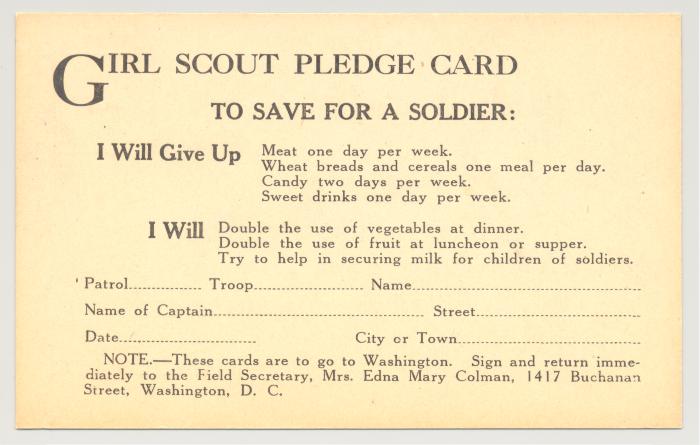
Girl Scout Pledge Card "To Save for a Soldier" (1914).
Written by Elizabeth Srsic | March 30, 2026
SAVANNAH, GA - “Uncle Sam needs the services of every one of his girls to keep the supply line moving,” Girl Scout founder Juliette Gordon Low rallied in 1918. “Come and join the scouts and help win the war.” So began her effort to urge the Girl Scout Movement she launched in 1912 to address vital wartime needs. In 1915, Girl Scouts had a mere 3,000 members; only three years later, the organization had grown to 100,000 Girl Scouts all working to support the war effort.
Juliette was living in Scotland when the war broke out and returned to the United States a year later. Her time in Great Britain gave her a close look at what Girl Guides did in service to the war effort and convinced her that Girl Scouts could play a similar role. Long before the United States joined the war, Girl Scouts did their part to support their Girl Guide sisters overseas by knitting garments for Belgian refugees, making dressings for wounds, and fundraising for the Red Cross. As Juliette and Dr. Abby Porter Leland, the national director of Girl Scouts of the USA (GSUSA) in 1917, said in a letter to Girl Scout captains later that year, “The Scout laws and promise are of no value unless translated into deeds of real service.”
In April 1917, the GSUSA National Board sent a telegram to President Wilson offering help with the war effort. Beginning with the National Red Cross, Girl Scouts teamed up with at least six departments of the federal government: Treasury, Agriculture, Labor, War, Food Administration, and Council of National Defense.
With the help of the Food Administration, Girl Scouts designed “To Save for a Soldier” pledge cards. By signing these cards, girls agreed to eliminate candy two days a week and meat and sweet drinks one day a week, while limiting wheat products to one meal a day. They pledged to eat more vegetables and fruits so that other foods could be shipped abroad to U.S. soldiers and allies. These efforts also provided milk for soldiers’ children.
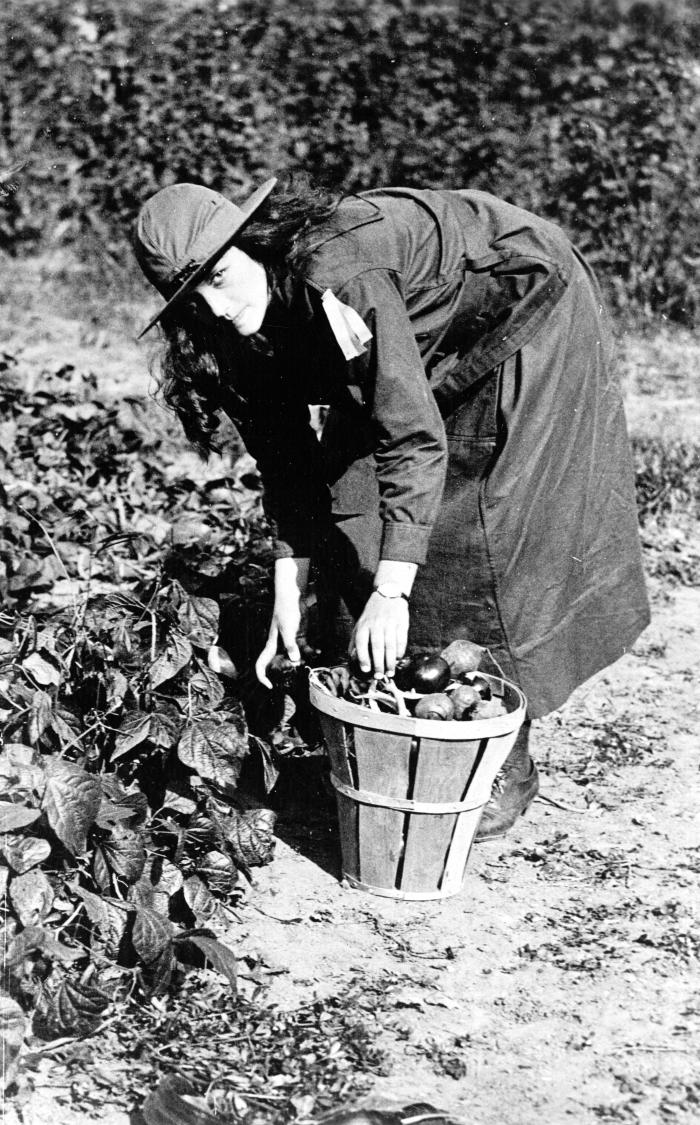
Harvesting Vegetables From Victory Garden, (1918).
At GSUSA’s annual convention in May 1917, leadership made plans “to form a girl agricultural army” to add to the nation’s food resources. The result was “victory gardens”; girls grew food for their families (some even raised chickens and pigs!), which allowed crops from large farms to be sent overseas to military troops.
Girl Scouts also learned about food conservation from the Food Administration, such as how to stretch food resources as far as they could go, and they put their new knowledge to good use by showing others how to preserve and can food.
Not everything the girls did was sponsored by a government agency. Some Girl Scout troops supported children who had become orphans because of the war by hosting fundraisers and making and selling bread. “Victory breads” used less wheat by substituting potatoes for the missing wheat and used corn syrup instead of sugar. In Knoxville, Tennessee, Girl Scouts had a booth in the business district where they registered women for volunteer efforts. Girls across the nation collected peach and other fruit pits, along with nutshells, to make carbon for soldiers’ gas masks, and girls in the nation’s capital distributed sandwiches to soldiers passing through.
To encourage girls’ involvement in volunteering, in partnership with the U.S. Treasury Department, GSUSA created a Girl Scout War Service Medal, earned by selling ten Liberty Bonds, and a Girl Scout War Service Pin, earned for providing many different services, including knitting, preserving jam or jelly, and selling bonds. Girls were awarded a total of 1,623 War Service Medals and 2,129 War Service Pins.
By war’s end in November 1918, GSUSA was established as a well-known organization throughout the United States and could proudly point to the many ways its members had contributed to hundreds of communities as leaders willing to take on whatever challenges were presented to them.
Research Sources
“150,000 Girl Scouts to Aid Food Administration, ‘To Save For A Soldier’, is Their Pledge,” Palladium-Item, Richmond, IN, October 15, 1917.
“Girl Scouts and War: Nearly One Hundred Thousand Are Doing Not Their Bit, But Their Best,” Star Tribune, Minneapolis, MN, August 12, 1918; “Girl Scouts of Buffalo,” The Buffalo Times, Buffalo, NY, December 22, 1917.
“Girl Scouts as the ‘Fourth Line of American Defense’,” Daily Ardmoreite, Ardmore, OK, May 26, 1918.
“Girl Scouts During the Great War,” Edith Bolling Wilson Birthplace Foundation and Museum, www.edithbollingwilson.org.
“Girl Scouts to Aid in War,” The Des Moines Register, Des Moines, IA, April 13, 1917.
Letter from National Headquarters Girl Scouts to Girl Scout Captains, August 29, 1917.
“Notes About Women,” The Des Moines Register, Des Moines, IA, May 2, 1917.
Proctor, T. M. (2009). Scouting for Girls: A Century of Girl Guides and Girl Scouts. Praeger.
Stacy A. Cordery, Juliette Gordon Low: The Remarkable Founder of the Girl Scouts (New York: Penguin Group, 2012), 247.
“The President of the Girl Scouts Tells What a Girl Can Do,” The Houston Post, Houston, TX, May 5, 1918.
“World War I and the Girl Scouts,” Georgia Historical Society, www.georgiahistory.com.
